
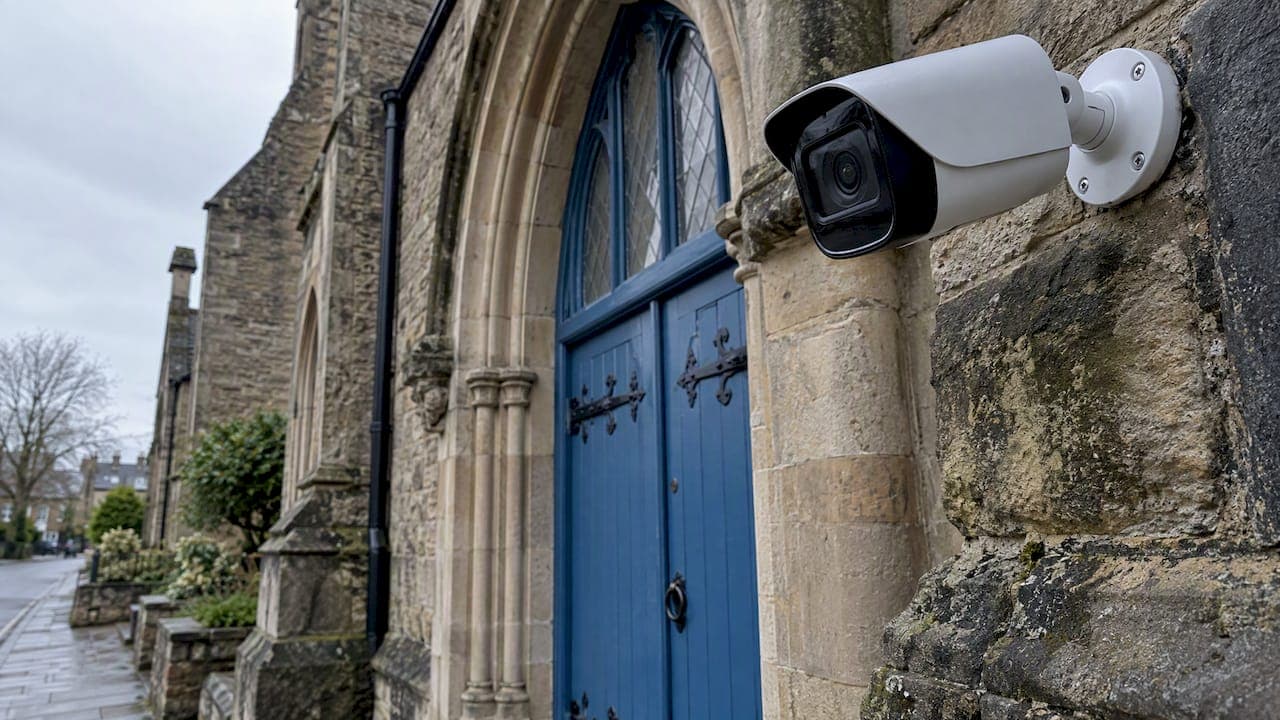
A good church security system starts with a survey of your building, not a shopping list. It then layers a monitored intruder alarm, CCTV that covers the blind spots, sensible access control and a written plan for the people who use the building. In England and Wales, the Home Office may also pay for part of it through a protective security scheme for places of worship.
This guide covers what to fit, in what order, what each part is for, and how to avoid turning an open, welcoming church into a fortress. We design, install and certify these systems for places of worship in Liverpool and the North West, so the advice below comes from that work.
TL;DR
- Start with a risk assessment of your own building, its people and its activities, then keep measures proportionate to the risks you find.
- The core kit is a monitored intruder alarm, CCTV with no blind spots, controlled entry to the areas that are not public, and good external lighting and locks.
- The Home Office's Places of Worship Protective Security Scheme may fund CCTV, alarms, doors, locks, fencing, lighting and more for churches in England and Wales. Check the official page for whether applications are open.
- A policy is only as good as the people who run it: agree who is responsible for security, and practise your emergency plans.
- Ask for one named engineer to survey, specify and certify the system, and get a fixed written quotation.
Table of Contents
- What a church actually needs to protect
- Start with a risk assessment
- The layers of a church security system
- Do you need a security team?
- Can you get funding for church security?
- A sensible order of work
- How to choose an installer for a church
- Our perspective: protect the welcome
- Talk to us about your church
- FAQ
- Sources
What a church actually needs to protect
Churches are unusual buildings to secure. They are open to the public for long stretches. They hold items that are valuable or irreplaceable: lead on the roof, silver, instruments, sound equipment, records. They are often run by volunteers, and many share space with toddler groups, food banks, lunch clubs and community lets.
That mix pulls in two directions. You want the building welcoming, and you want it protected. The right system does not choose between them. It protects what needs protecting quietly, and leaves the nave open.
Before choosing any equipment, write down what you are protecting against. Typical answers include:
- theft of metal, equipment or collection money
- vandalism and graffiti
- arson
- unauthorised access to offices, vestries, crèche rooms or a church hall
- hate crime directed at the congregation or the building
- the safety of people during services and events
Each of these points to different measures. Roof theft is a perimeter and detection problem. Safeguarding in a children's room is an access control problem. Hate crime is a mix of visibility, deterrence and rapid response.
Start with a risk assessment
Guidance from the Church of Scotland tells churches to look at existing security measures, the people and activities in the buildings, movement and entry points, possible unauthorised access and evacuation routes. It also says to keep measures proportionate to the risks and to be realistic about your location and the likelihood of threats. It is Scottish guidance, but the method suits any church.
In practice, walk the site with two or three people who know it well, ideally including whoever opens up and whoever locks up. Go round at the times the building is busiest and at dusk. Ask:
- Which doors and windows can someone reach unseen?
- Where are the dark corners, and what is lit at night?
- Which rooms hold valuables, and who has keys?
- Who is in the building alone, and when?
- If something went wrong during a service, how would people leave, and how would you call for help?
The answers become your brief for a security installer. A good installer will walk the same route and tell you what they would change. If a firm quotes without visiting, be cautious: the building decides the system, not a catalogue.
The layers of a church security system
Think in layers: deter, detect, delay, respond. Each layer does a different job, and none is enough alone.

Perimeter, lighting and physical protection
The first layer is the one people see. The government's scheme lists secure fencing or gates, stronger doors and locks, window protection and external lighting among the measures it may fund, as set out in the Places of Worship Protective Security Scheme guidance. Church of Scotland guidance also suggests using existing fences, walls and gates to establish a perimeter.
For most churches this means:
- good locks and reinforced doors on vestries, offices, tower access and any door that is not part of the main entrance
- protection for vulnerable windows, especially at ground level and round the back
- lighting that makes the building visible from the road, ideally with sensors on the quieter sides
- tidy planting, so shrubs do not hide people from view
Physical measures delay an intruder. Delay is what gives the alarm and the response time to work.
Intruder alarms
An intruder alarm is the backbone of church security because it works when nobody is there, which is most of the week. The choices that matter:
- Detection zones. The nave, vestry, hall, office and any treasury or store should be separate zones, so you know where an intrusion is happening. Large open spaces with high ceilings need detectors chosen for the room, not just the cheapest option.
- Monitoring. An alarm that only sounds a bell relies on a neighbour to react. A system connected to an alarm receiving centre can pass a verified activation to the police. As BIBA explains, installers of systems that meet police rules and the applicable standards can request a police unique reference number, which lets the monitoring centre contact the police control room directly. A bare 999 call from someone hearing a bell is a different thing.
- Certification. Ask whether the installer is certified by an inspectorate such as SSAIB. That is what allows a system to be installed to the standards the police and insurers expect.
- Insurance. Your church insurer may set conditions on alarms, so tell them before you buy and keep the paperwork.
We design and fit commercial-grade intruder alarms, including SSAIB-certified systems and police-response monitored options. Those same systems suit churches and church halls.
CCTV
CCTV does three jobs: it deters, it verifies an alarm and it gives you evidence. Church of Scotland guidance recommends installing CCTV to eliminate blind spots, depending on the risks identified.
A few practical points that save money and regret:
- Place cameras for the problem. Cover entrances, the sides and rear of the building, the car park, and any area where theft or damage has happened. Cameras pointing at the congregation during worship are rarely needed, and they change the feel of the place.
- Choose image quality for the job. Recognising a face at a door needs more than spotting movement across a churchyard. Lighting matters as much as the camera.
- Plan for remote viewing. Being able to check the building from a phone, or have alerts sent to a named keyholder, turns a camera from an archive into a live tool. Our CCTV and remote monitoring service is built around that.
- Follow data protection rules. If cameras capture people on or beyond your land, put up clear signs, decide who can view footage and how long you keep it. The Information Commissioner's Office publishes guidance on this for organisations.
- Keep it maintained. A camera that stopped recording in March is no use in October. Servicing is part of the system, not an extra.
Access control and door entry
This is the layer many churches skip and later wish they had added. Keys get copied, lost and never returned. Access control replaces them with fobs, cards or codes that can be switched off individually, and it records who came in and when.
It is especially useful for:
- offices and vestries that only a few people should enter
- church halls let to outside groups
- children's and youth areas, where you want to control who comes and goes
- out-of-hours use, such as a cleaner, a band practice or a community group
The government scheme lists entry systems among the measures it may fund. Our access control and door entry systems can be set so the main doors stay open for worship while the rest of the building stays controlled. An intercom at a side or office entrance is a simple way to see and speak to visitors before letting them in.
Emergency communication
Systems cover the building. Plans cover the people. Nottinghamshire Fire and Rescue Service says every place of worship should have clear, accessible plans for fires, medical emergencies, natural disasters and potential security threats. It also says fire safety inspections help identify risks and that its guidance can help ensure evacuation routes and assembly areas are appropriate and well maintained.
For security specifically, think about how a steward would raise the alarm discreetly, how the minister or leader would be told, and how the building would be locked down or emptied. For schools and event centres we install dedicated lockdown systems, and the same thinking applies to a church that runs a school, a large event or a nursery on site.
Do you need a security team?
Many readers ask whether a church should have a security team. For most UK congregations, the honest answer is a small, clear group rather than anyone in a uniform.
US federal guidance on houses of worship advises establishing clear roles and responsibilities for security decisions and plans, and exercising emergency and incident response plans with the Safety Team. The American context is different from ours, but the principle carries over.
A workable version for a typical parish or congregation:
- one named person responsible for security decisions, usually a churchwarden, trustee or property officer
- stewards or welcomers who know what to look out for and who to tell
- a keyholder list that is reviewed at least once a year
- a short written procedure for opening, locking up and reporting incidents
- a practised response to a fire, a medical emergency and a threatening person
Church of Scotland guidance adds that people should stay vigilant and challenge people who enter or loiter on church property. Challenging is best done in a friendly way: a greeting and an offer of help works better than confrontation, and it is hard to say to someone who has come to pray.
Can you get funding for church security?
Often, yes, and many churches do not know it. The Home Office runs the Places of Worship Protective Security Scheme, offering funded measures to places of worship and faith community centres in England and Wales that are at risk of hate crime. Churches are named as eligible. The scheme covers installation and one year of maintenance.
What it may fund includes CCTV, secure fencing or gates, stronger doors and locks, window protection, intruder alarms, entry systems, external lighting and secure mailboxes.
What it does not cover is just as important:
- planning permission fees
- general building work
- upgrades for outdated systems
- issues unrelated to hate crime, such as anti-social behaviour
So a church that mainly has a problem with youths in the churchyard, or wants to replace an old alarm, may not qualify. A church concerned about hate crime may.
Jewish and Muslim communities have separate schemes, and the government's page on protective security for faith communities lists them, along with free Faith Security Training for faith communities across England and Wales. The Home Office checks applications to make sure organisations meet the required standards.
The scheme has opened and closed in rounds, so do not rely on any article for the current position, including this one. Read the official page for whether the application portal is open, and gather your information before it does. A site survey from an installer helps here, because it gives you a clear description of the measures you would ask for.
If your church is outside England and Wales, other routes apply. Scotland and Northern Ireland have their own bodies and guidance.
A sensible order of work
If you cannot do everything at once, this sequence gives the most protection per pound:
| Step | What to do | Why it comes here |
|---|---|---|
| 1 | Risk assessment and walk-round | Everything else depends on it |
| 2 | Fix locks, doors and vulnerable windows | Delay is cheap and effective |
| 3 | Fit a certified, monitored intruder alarm | Protects the building when empty |
| 4 | Add CCTV on entrances, rear and car park | Verifies alarms and gives evidence |
| 5 | Add access control to offices, halls and children's areas | Replaces uncontrolled keys |
| 6 | Improve external lighting | Makes everything above work better |
| 7 | Write and practise emergency plans | People make the systems useful |
If you are applying for funding, your order may follow what the scheme allows rather than this table. Ask your installer to price each step separately so you can fund and phase the work.
How to choose an installer for a church
Churches are not like shops or offices, so ask a few questions of anyone who quotes:
- Who will survey, who will install? A salesperson who visits and then hands over to a subcontractor can lose detail in the handover. Ideally the person who specifies the system installs it.
- Are they inspectorate-certified? SSAIB certification is the sign to look for on alarms. You can see how we are accredited.
- Is the quotation fixed and itemised? You should see each part and the cost of installation, so you can compare and phase.
- How tidy will the work be? Cables across old stonework or a listed interior need care. Ask how they would route them and whether they have worked in historic buildings.
- What happens afterwards? Ask about servicing, remote support and callouts. Alarms and cameras need annual attention.
- Do you need extra permissions? For a listed building or a church under faculty jurisdiction, check with your diocese or denomination before fitting anything on the fabric.
Our perspective: protect the welcome
We have spent over 20 years designing and installing security for homes, schools, places of worship and businesses across Liverpool and the North West. The mistake we see most often at churches is not too little security, it is the wrong security: a camera aimed where nothing happens, an alarm nobody can reset, keys that nobody can account for.
Our view is simple. Start from the building and the people in it. Use as little visible hardware as the risks allow, put the detection where an intruder has to pass it, and make everything easy for volunteers to use on a wet Tuesday night. A system that confuses the person locking up will be switched off.
That is why every system we fit is specified, installed and certified by the same experienced engineer, with no salespeople or subcontractors in between. The person who stands in your nave and listens to your concerns is the person who builds the answer, and who answers the phone afterwards.
— User
Talk to us about your church
We survey places of worship across Liverpool and the North West and give you a clear fixed quotation for alarms, CCTV with remote viewing, access control and intercoms, all installed directly by one of our engineers. We also offer servicing, maintenance and 24-hour callout once the system is in. If you are applying to the Home Office scheme, a survey gives you a clear specification to work from. Start with our commercial security page or get in touch through our website.
FAQ
What security measures should every church consider?
Start with a monitored intruder alarm, CCTV covering entrances and blind spots, good locks and doors, and external lighting. Add access control for offices, halls and children's areas. Government guidance on funded measures lists these and others, including fencing, window protection and entry systems.
Does the government pay for church security?
It can, in England and Wales. The Places of Worship Protective Security Scheme offers funded security measures to churches and other places of worship at risk of hate crime, including installation and one year of maintenance. It excludes things like general building work and upgrades to outdated systems, so read the official guidance before you apply.
Should a church have a security team?
Most churches need a small, clearly defined group rather than guards. Name one person responsible for security, brief stewards on what to watch for and who to tell, keep a reviewed keyholder list and practise your emergency plans.
What is the 80% rule for churches?
It is a church-growth rule of thumb, not a security standard. It says that once a building is about 80 per cent full, attendance tends to stop growing. It has no bearing on how you secure the building, which depends on your own risk assessment.
Sources
- Places of Worship Protective Security Scheme, GOV.UK
- Protective security for faith communities, GOV.UK
- Security Evaluation (Risk Assessment), Church of Scotland
- Protecting places of worship, Nottinghamshire Fire and Rescue Service
- Mitigating Attacks on Houses of Worship Security Guide, CISA
- Intruder Alarms: Guidance for purchasers, BIBA
- The 80 Percent Rule: Myth, or Fact?