
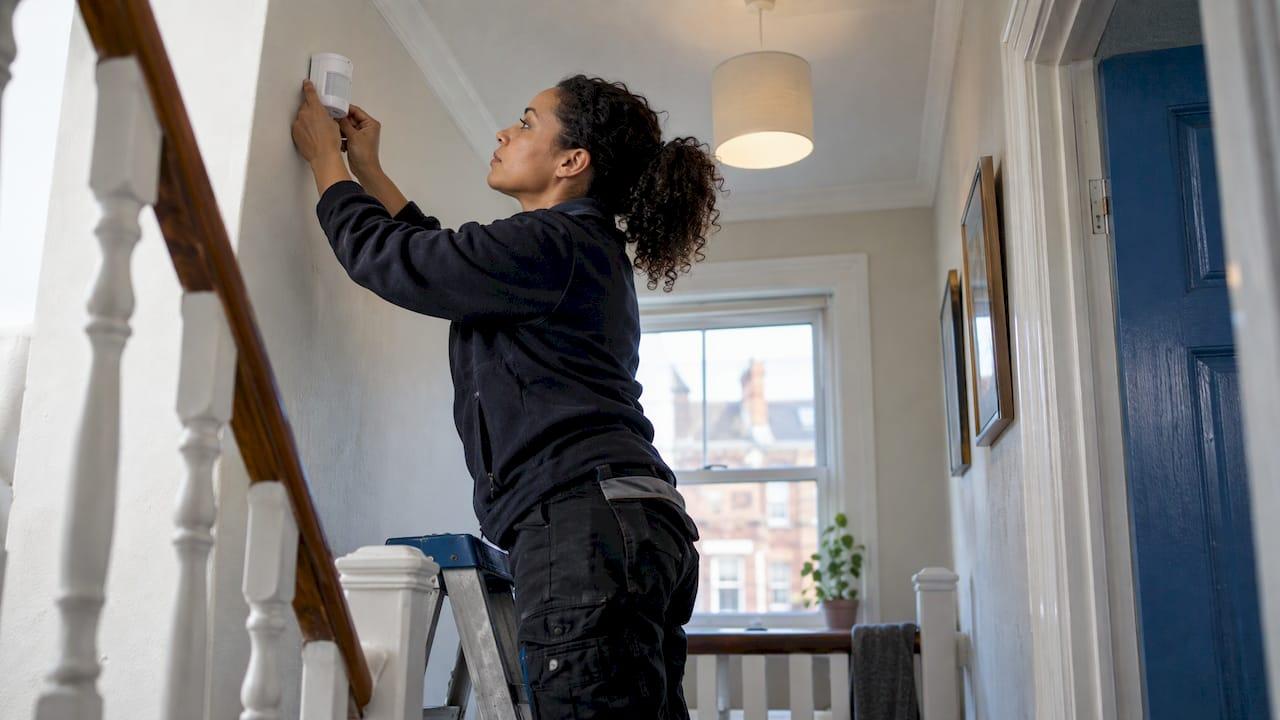
The right burglar alarm for a Liverpool home is a professionally installed, graded system that suits your insurer's requirements, covers every vulnerable entry point and, if you want police attendance, is monitored by an approved alarm receiving centre. Bells-only boxes and app-based smart kits have their place, but the type, grade and monitoring you choose decide what actually happens when someone breaks in. This guide explains the options in plain terms, what the standards mean, and what to agree with an installer before any work starts.
TL;DR
- There are three broad routes: audible-only alarms, monitored alarms (keyholder or police response) and smart systems you control from a phone. Many homes combine them.
- Police response in Merseyside generally depends on a police-compliant monitoring company holding a Unique Reference Number (URN) for your installation.
- Ask your insurer which grade they require. Grade 2 is commonly asked for, with grade 3 for higher-risk properties.
- Insist on a written specification, a written fixed price and a Certificate of Conformity.
- Plan for servicing from day one. Monitored systems normally need a maintenance contract, and older phone-line signalling may need updating.
Table of Contents
- The main types of burglar alarm for a Liverpool home
- Wired or wireless: which suits your property?
- What grading means and why your insurer cares
- Monitoring, keyholders and police response
- Where the sensors go: lessons from Merseyside Police
- Servicing, batteries and the phone-line switch-off
- How to arrange installation, repair or an upgrade
- Alarms for schools, nurseries, places of worship and businesses
- Fitted alarms from Impact Security Systems
- FAQ
- Sources
The main types of burglar alarm for a Liverpool home
Merseyside Police describes three types of alarm: monitored, unmonitored and auto-dialler. Understanding the difference is the quickest way to narrow your choice.
Audible-only (bells-only) alarms
An unmonitored alarm sounds a loud siren to scare off an intruder and alert neighbours. Aviva's guidance notes that a bells-only alarm rings for up to 20 minutes before cutting off, and does not contact the police or a nominated person. That makes it only as effective as the people who hear it. On a quiet cul-de-sac in Woolton or a terrace in Allerton with neighbours out at work, nobody may act.
Auto-dialler alarms
An auto-dialler texts or phones pre-programmed keyholders when the alarm activates. Merseyside Police advises that it should not be set up to call the police directly, because police response is organised through monitoring companies, not through a number dialled from your panel.
Monitored alarms
A monitored alarm sends a signal to a 24-hour monitoring centre. Aviva explains that monitoring can be keyholder-based or police-based, usually for a monthly or annual fee. Merseyside Police says its officers will typically respond when a police-compliant monitoring company that has registered the installation and issued a URN requests it, and that the force is less likely to attend unmonitored alarms or systems that fall short of current guidelines.
Smart alarms and app control
Smart systems connect devices to a hub over Wi-Fi so you can arm, disarm and check activity from a phone or tablet. SSAIB says a basic system might include an external bell box with a flashing light, a keypad, motion detectors and door and window contacts, while smart packages can add a Wi-Fi camera, video doorbell and an app. For most households the best result is a properly graded alarm with app control layered on top, rather than app control alone.
Wired or wireless: which suits your property?
Both wired and wireless systems can be installed to a professional standard. The choice usually comes down to the building rather than a general rule.
| Factor | Wired | Wireless |
|---|---|---|
| Best suited to | Renovations, new builds, properties with accessible cable routes | Occupied homes, period properties, extensions where cabling is awkward |
| Disruption during fitting | Greater, as cables are run through walls and ceilings | Usually lower |
| Adding sensors later | Possible, but depends on cable routes | Typically simpler |
| Battery care | Panel back-up battery | Panel and detector batteries need regular attention |
Liverpool has a great deal of Victorian and Edwardian housing, from Georgian terraces near Princes Park to bay-fronted semis in Mossley Hill. Decorative plasterwork and floorboards you want to keep often favour wireless detectors. A new-build estate or a full refurbishment is a good moment to consider wired. A competent surveyor will walk the property and recommend one or a mix, which is why a site survey matters more than a catalogue.
What grading means and why your insurer cares
Alarm grades are the part most homeowners are never told about until a claim. BIBA, the insurance brokers' association, explains that PD 6662 requires systems to meet a security grade from 1 to 4, with grades 2 and 3 most often required. Insurers typically regard grade 2E as suitable for lower-risk homes, grade 2 for higher-risk homes and lower-risk commercial premises, and grade 3 for high-risk homes and most commercial premises. Grade 1 is disregarded by insurers and grade 4 is rarely called for.

Standards matter as well. ProtectUK states that monitored systems should conform to BS EN 50131, BS 8243 and BS EN 50518, while audible-only systems should conform to BS 4737-3.0 or BS EN 50131-1. You do not need to memorise these. You do need an installer who works to them and will say so in writing.
Before you buy, ring your home insurer. BIBA advises seeking insurer advice or approval before purchase, and NSI notes that an insurer may insist on an alarm and specify the grade depending on your property's risk level. Getting this wrong means paying twice.
Monitoring, keyholders and police response
This is where a fitted home alarm earns its money. Here is how the chain works.
- The alarm triggers and sends a signal to an approved alarm receiving centre (ARC).
- The ARC checks the signal, often by confirming a second trigger or by audio or other verification.
- If it is confirmed, the ARC contacts the police, your keyholders or a keyholding service.
NSI states that to get police response in the UK you need an approved installer recognised by the police and an approved ARC, and that systems newly installed since June 2019 must conform to PD 6662:2017 and BS 8243 to receive police response in England, Wales and Northern Ireland. Immediate police response is withdrawn after three false alarms in a rolling twelve months, with reinstatement possible once the cause is identified and fixed.
BIBA adds that providing the ARC with contact details for at least two keyholders, each able to reach the property within 20 minutes, is vital to obtaining a police URN. Choose keyholders who live or work nearby and tell them they are on the list. The National Police Chiefs' Council also issued an updated 2025 policy for police response to security systems, with stronger documentation requirements and revised false alarm definitions, so ask your installer how their process reflects it.
Where the sensors go: lessons from Merseyside Police
A well-graded alarm can still fail if the coverage has gaps. Merseyside Police's advice is practical and worth following:
- Mount audible alarm boxes high at the front and rear of the house. Two visible boxes are better than one.
- If you have built an extension or converted a loft, extend the alarm to cover it.
- Cover upper rooms as well as the ground floor. Burglars have been known to use ladders to reach upper windows that look unlocked, avoiding ground-floor sensors.
- Use alarm signage. It works as a deterrent when the system is actually active.
It is a good test of any quotation: does it mention the extension, the first-floor landing and the rear of the house? If the specification covers only the hallway and the downstairs living room, ask why.
Our view: design the alarm around the property, not the product
We are asked every week which alarm is best. The honest answer is that it depends on the house, the people in it and what your insurer expects. That is why every system we install is specified, installed and SSAIB-certified by the same experienced engineer, with no salespeople and no subcontractors between you and the person doing the work.
In our experience that matters most at the design stage. The engineer who stands in your hallway and notices the loft conversion, the side gate and the conservatory door is the same one who fits the detectors and signs off the certificate. Nothing is lost in translation, and if something needs adjusting afterwards you know exactly who to call.
We believe an alarm should come with a clear fixed quotation, a tidy installation, proper aftercare and genuine 24-hour support. For homes that want police attendance, we design monitored systems around the standards described above, and we offer remote monitoring and app control so you can see what your property is doing from wherever you are.
Freddie
Servicing, batteries and the phone-line switch-off
An alarm is not a fit-and-forget purchase. NSI says audible alarms should be checked once a year, while systems signalling to an ARC should be serviced twice a year, and that batteries should be replaced before they degrade. SSAIB adds that a maintenance contract will almost certainly be a condition of insurance and is mandatory for police-calling systems. Regular servicing also reduces the risk of false alarms, which matters because repeated ones can cost you police response.
Older systems face a second issue. Travelers reported that the UK's analogue telephone network was due to be switched off by the end of December 2025, after which calls and signalling run over the internet, and that insurers normally expect replacement signalling to perform at least like for like. If your alarm was fitted a decade or more ago and signals over a landline, check how it now reaches the ARC. The Collections Trust notes that systems relying on the old network needed replacing or updating, and recommends dual-path signalling (DP3 or DP4) so the ARC learns quickly if both signal paths fail.
If you moved into a Liverpool home with an existing alarm and no paperwork, you have a system takeover situation: an engineer needs to assess it, confirm it meets current requirements and register it properly before you rely on it.

How to arrange installation, repair or an upgrade
Use this order and you avoid the usual problems.
- Call your insurer first. Ask whether they require an alarm, which grade and whether it must be monitored.
- Choose a certified installer. SSAIB says that using an SSAIB-certified company assures you the installer has been checked for technical competence and professional conduct.
- Get a survey, not just a price list. The installer should walk every floor and the exterior.
- Agree a written specification. SSAIB recommends this, along with a written fixed price and comparing quotes from around three installers.
- Do not choose on price alone. BIBA warns that the cheapest quotation may produce a system that fails to meet your or your insurer's expectations and is hard to alter later.
- Confirm ownership and contracts. Check whether the system is purchased or leased, and what the maintenance and monitoring terms are.
- Require a Certificate of Conformity. SSAIB advises making sure one is issued for the installed system. Keep it with your insurance papers.
- Book the first service before you leave the subject, not when something goes wrong.
When listening to the technical explanation, SSAIB's advice is sensible: take in the guidance, but do not be bamboozled by jargon. A good engineer explains in plain English why each detector is where it is.
Alarms for schools, nurseries, places of worship and businesses
The same principles apply to organisations, with higher stakes. ProtectUK stresses that detection should be reliable, fit for purpose and linked to an alarm that alerts site operators or the police through an approved ARC. NSI notes that its approved companies can assess risks and design systems to the standards the police and insurers require, and that commercial insurers often specify grades. Most commercial premises sit at grade 3 in insurers' typical thinking, which affects the design from the outset.
In practice, a Liverpool nursery, church hall, warehouse or office usually wants more than a siren:
- an intruder alarm with police-response monitoring and named keyholders;
- CCTV and remote monitoring so you can verify what set the alarm off;
- access control and door entry so the right people enter at the right times;
- servicing arranged around term times, opening hours or events.
We cover sector specifics on our pages for construction sites and leisure and public venues, and our commercial intruder alarm service explains how we approach larger premises. You can also see our accreditations before you commit.
Fitted alarms from Impact Security Systems
We design, install and SSAIB-certify burglar alarms for homes across Liverpool and the North West. Every job is handled by the same engineer from survey to sign-off, and you receive a clear fixed quotation before work starts. Our systems can include remote monitoring and app control, and we can set up police-response monitored systems, annual servicing, SSAIB-certified maintenance and a 24-hour callout.

With more than 20 years in the field and a 5.0 rating from 44 Google reviews, we would be glad to survey your property and talk you through the options. See our home security services or arrange a service and maintenance plan for an existing system.
FAQ
Will the police respond to my burglar alarm in Liverpool?
Merseyside Police says its officers will typically respond when a police-compliant monitoring company has registered the installation and issued a URN. The force is less likely to attend unmonitored alarms or systems that do not meet current guidelines. Ask your installer to confirm in writing how police response will be arranged.
Which alarm grade do I need for my house?
BIBA says insurers typically regard grade 2E as suitable for lower-risk homes, grade 2 for higher-risk homes and grade 3 for high-risk homes. Your insurer has the final say, so ask them before you request quotes. A certified installer can then specify the system to match.
How often should a burglar alarm be serviced?
NSI says audible-only alarms should be checked once a year and systems signalling to an alarm receiving centre serviced twice a year. SSAIB adds that a maintenance contract is mandatory for police-calling systems. Replacing batteries before they fail is part of that routine.
Is a smart alarm enough on its own?
Smart systems let you monitor your home from a phone, and Aviva describes them as a main alarm category. If you want police response or to meet an insurer's grade, the system also needs to be installed and monitored to the relevant standards. Many homeowners choose a graded alarm with app control added.
What paperwork should I get after installation?
SSAIB advises making sure a Certificate of Conformity is issued, alongside your written specification and fixed price. Keep these with your insurance documents, and note the servicing schedule so the system stays compliant.
Sources
- Keep burglars out of your property, Merseyside Police
- Which alarm system should you get for your home?, Aviva
- Alarm systems, SSAIB
- Intruder Alarms: Guidance for purchasers, BIBA
- Alarms and CCTV, ProtectUK
- Intruder alarm systems for business and commercial premises, NSI
- NPCC 2025 policy update for police response to security systems, NSI
- FAQs about security and fire safety in the home, NSI
- PSTN switch-off announcement, Travelers
- Intruder alarm systems, Collections Trust