
A custom security system is one designed around your building, your risks and the people who use it, rather than a boxed kit chosen from a shelf. It starts with a survey, produces a written specification and fixed quotation, and is installed, tested and handed over with proper documentation. This guide explains what goes into one, how the design process works, which UK rules apply, and what homes, schools, nurseries, places of worship and businesses should ask before they sign.
TL;DR
- A bespoke system is built from a site survey: the layout, the risks and the way people move through the building decide the alarms, cameras, access control and intercoms, not a standard package.
- Good design follows a sequence: operational requirements, specification, installation, commissioning, handover, then a maintenance schedule.
- CCTV in the UK must be lawful, necessary and proportionate under UK GDPR, and schools and businesses have specific duties to meet.
- Places of worship in England and Wales may be able to get government funding for protective security.
- At Impact Security Systems, the engineer who specifies your system is the one who installs and certifies it. We do not use salespeople or subcontractors.
Table of Contents
- What "custom" actually means in security
- What a custom system can include
- How a bespoke design is built, step by step
- Designing for different properties
- The rules that shape a UK system
- Our view: accountability is the real customisation
- Working with Impact Security Systems
- What to ask before you sign
- FAQ
- Sources
What "custom" actually means in security
Most people searching for bespoke, tailored or custom security systems want the same thing: protection that fits their property instead of a generic package that leaves gaps or charges for features they will never use.
In practice, custom means four things:
- The design starts with the site. A Victorian terrace in Wavertree, a primary school with several entrances and a warehouse yard on the edge of town have different weak points, different occupants and different routines.
- The equipment is chosen to suit the risks. Detectors, cameras, door controllers and intercoms are specified for the location, not bundled because they sit in the same box.
- The parts work together. The alarm, cameras, door entry and network are planned as one system rather than three separate purchases that never talk to each other.
- The aftercare is planned in. Servicing, monitoring and callout arrangements are agreed at the start, because a system that is not maintained slowly stops protecting you.
The UK National Protective Security Authority (NPSA) identifies four broad electronic-security areas that may be integrated: intruder alarm systems, automatic access-control systems, CCTV and perimeter intruder-detection systems. A custom design decides which of these you need, how far each should go and how they connect.
What a custom system can include
The building blocks are the same across homes and commercial premises. What differs is the mix and the scale.
Intruder alarms
Government security guidance describes an intruder-detection system as one that detects entry or attempted entry into a protected area, identifies where it happened and signals an alarm for a response. The same guidance also lists panic alarms as a security measure, which matters for reception desks, shops and any site where staff work alone.
A custom alarm divides the building into zones that match how it is really used. A house might separate the ground floor from the bedrooms so you can set the alarm at night while moving about upstairs. An office might separate the server room and stock room from open-plan areas. Our commercial intruder alarm service and home burglar alarms are both specified this way.

CCTV and remote monitoring
High-definition cameras are only useful if they are placed to capture usable images: faces at entrances, vehicles at gates, the approach to a vulnerable window. A bespoke design considers lighting, camera angles, recording capacity and how you will view footage, whether on site or through an app. Our CCTV and remote monitoring systems are designed around those questions.
Access control and door entry
Access control decides who can go where and when. That could be fobs for staff, keypads for a back door, timed access for cleaners or visitor control from reception. Our access control and door entry work covers these setups for schools, offices, community buildings and commercial units.
Intercoms and smart doorbells
Intercoms let you see and speak to a visitor before letting them in. At home that might be a smart doorbell on your phone. In a nursery or school it is often an entry system at the main door. See our intercom systems for commercial sites.
Networks, Wi-Fi and cabling
Cameras, door controllers and remote access all depend on a stable network. We design and install Wi-Fi and networking alongside the security equipment, so the system is not left relying on a weak signal or a router in the wrong place.
Lockdown systems
For schools and event centres, we also offer lockdown systems. These need careful design around the site layout and the way staff would realistically respond, so they are never a bolt-on.
How a bespoke design is built, step by step
Official guidance on security design is consistent about the order of work. The NPSA's guidance on perimeter intrusion detection says design should begin with detailed operational requirements and consider the site and local environment, protected areas, physical constraints, integration, power and performance. Translated into what happens on a typical job:
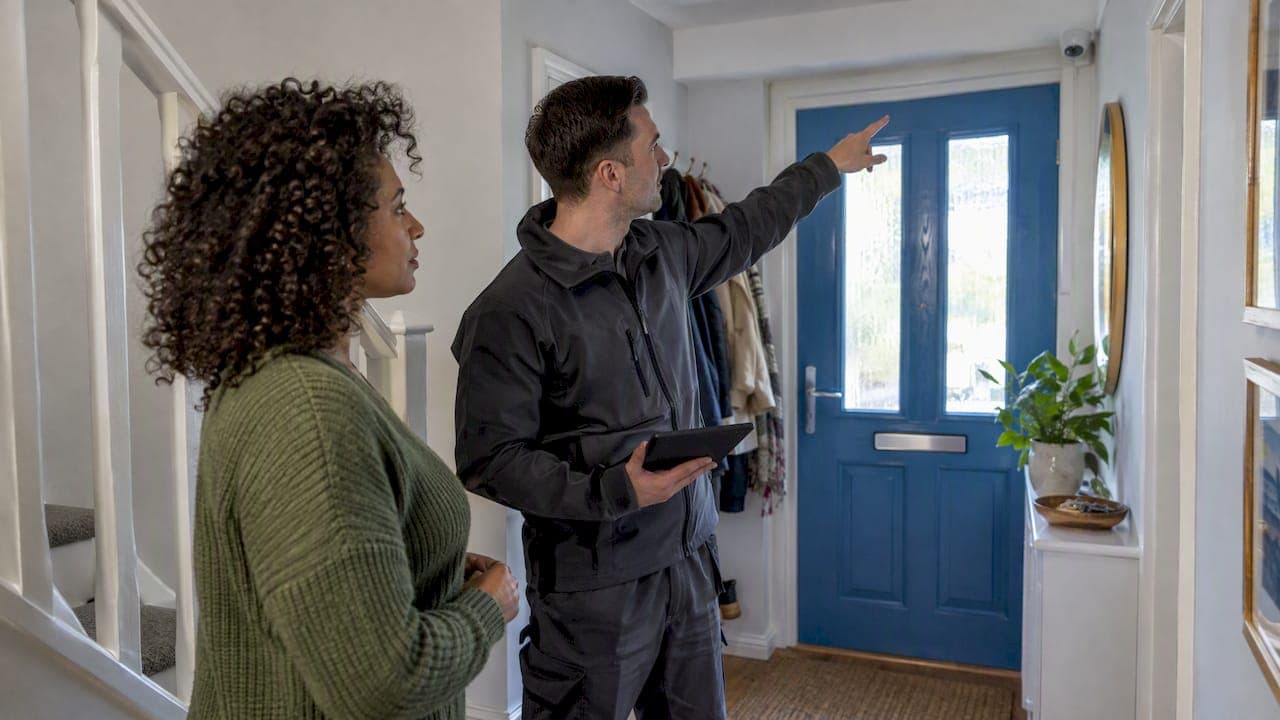
- Survey. An engineer walks the property, noting entrances, windows, blind spots, cable routes, power points, Wi-Fi coverage and anything that makes the site unusual.
- Risk and requirements. You describe what you are protecting and what has gone wrong before. The engineer asks who needs access, when, and what should happen if something fails.
- Specification. The equipment, positions, zones and features are written down so you can see exactly what you are buying.
- Fixed quotation. You receive a clear price for the specified work.
- Installation. Cabling and equipment go in tidily and to the manufacturer's procedures.
- Commissioning and testing. Every device is tested against the specification.
- Handover. You receive instructions and are shown how to use the system.
- Aftercare. Servicing and support keep it working.
The NPSA's guidance sets out the same sequence: from problem statement to operational requirement, specification, contract award, installation, commissioning and handover, followed by operation and a maintenance schedule. The same guide says handover should include drawings and manuals, operating instructions, system limitations, emergency procedures and maintenance instructions. If an installer cannot tell you what documents you will receive, ask before you commit.
Questions a good survey should answer
For access control, NPSA guidance says a bespoke design should define entry and exit points, user groups and peak flows, restrictions and zoning, failure and evacuation responses, as well as equality requirements and which existing doors and escape routes remain. In plain terms, before anything is fitted you should know:
- What happens to the doors if the power fails?
- Can everyone leave quickly in a fire?
- Who gets access at 8am, and who at 8pm?
- Can a disabled visitor or member of staff use the entry system?
- How is a lost fob cancelled?
If the quote does not answer these, the design is not finished.
Designing for different properties
Homes
Home systems should protect without making daily life awkward. That means pet-friendly detection, sensible zoning, cameras covering approaches rather than neighbours' gardens, and an app that is simple enough for the whole household. Smart home integration, doorbells and Wi-Fi are often planned together. Our work on a new-build residential property in Cheshire shows how that planning works from the cabling stage.
Schools and nurseries
Schools need to welcome people in while controlling who reaches pupils. Counter-terrorism protective security advice for schools says they should clearly demarcate public and private areas, keep vehicles other than staff cars at a safe distance, and check essential delivery and contractor vehicles before they come on site. The same advice says schools should use trained staff or good-quality access control, particularly in restricted areas, and that where access control is in place, photo passes should be strictly controlled and regularly reviewed.
Schools also have a legal duty here: they must carry out adequate risk assessments and meet their duties under the Health and Safety at Work Act 1974 and related regulations. A security design should feed into that assessment rather than sit apart from it.
For nurseries and schools, a typical bespoke package combines door entry with an intercom, controlled internal doors, CCTV at entrances and the playground boundary, an intruder alarm for out-of-hours, and where appropriate a lockdown system.

Places of worship
Churches, mosques, synagogues, temples and community centres are often open to the public, used irregularly and run by volunteers. That calls for systems that are easy to set, easy to explain and hard to lock people out of. The government's Places of Worship Protective Security Scheme says it may fund CCTV, secure fencing or gates, stronger doors and locks, window protection, intruder alarms, keypad, fob or intercom entry systems, external lighting and secure mailboxes for eligible places of worship and associated community centres in England and Wales that are at risk of hate crime. Check the official page for eligibility and the current application window before planning a project around it.
Offices, shops and commercial units
Businesses usually need a layered system: an alarm that can be monitored, cameras that cover entrances and stock, and access control that records who came in. We have documented an eight-zone office alarm installation and a wireless CCTV system for a haulage and agricultural site, two very different answers to the same question of what the site needs. Our commercial security overview covers the full range.
Construction sites
Sites change shape weekly, are exposed out of hours and hold costly plant and materials. Temporary systems need to be quick to deploy, powered sensibly and easy to move. See our construction sector page and a temporary site compound CCTV case study.
The rules that shape a UK system
CCTV and data protection
If you record people, you are processing personal data. The ICO says video surveillance should be lawful, fair, transparent and meet data protection standards under the UK GDPR and Data Protection Act 2018. It also describes CCTV as a supporting tool that should be lawful, necessary and proportionate, not a cure-all. That is a useful test for any design: if a camera cannot be justified, it should not go in.
Practical points from the ICO's guidance for organisations:
- Write down why you need CCTV, what areas it covers, how long you keep recordings and how you limit the impact on privacy. The ICO sets this out in its CCTV checklist for organisations.
- Avoid sensitive areas. The same guidance says cameras should not normally cover toilets or changing rooms.
- Consider a DPIA. A data protection impact assessment is needed if CCTV use is likely to result in high risk, for example cameras in private areas or monitoring staff.
- Store securely and delete on time. Footage must be kept securely and deleted once it is no longer needed, and many systems have an automatic overwrite feature to help.
- Schools may need to pay a fee. Educational establishments and independent schools must pay the data protection fee if they use CCTV for crime prevention on their premises.
For schools, the wider picture of data protection in education is worth reading alongside your CCTV policy, since camera footage sits next to pupil records and other personal data.
Certification and police response
Certification matters because it tells you the installer is independently inspected. Impact Security Systems is SSAIB-certified, and you can see our accreditations on our site.
Police response is a separate matter. A police-assigned Unique Reference Number (URN) flags a property for immediate police response when a verified alarm signal is triggered, and it is awarded only to systems that meet police requirements and are installed, maintained and monitored by approved companies. If police response is important to you or your insurer, say so at survey stage so the system is specified to qualify. We offer police-response monitored systems on that basis.
Approved equipment and maintenance
For higher-security access control, NPSA guidance says an assured installation can only be created using approved equipment and a correctly designed installation, supported by appropriate commissioning and later maintenance. Most homes and small businesses do not need that level, but the principle applies everywhere: good equipment badly installed or never serviced is a weak system.
For CCTV, the National Security Inspectorate says approved companies should carry out a risk assessment and site survey before design, and that maintenance arrangements should cover software and firmware updates, battery replacement, illumination and who pays for what. Ask any installer to put those points in writing.
Our view: accountability is the real customisation
We have installed security systems for more than 20 years, and our view is that most failed systems did not fail because of the equipment. They failed because the person who sold the system was not the person who fitted it, and nobody owned the gap between the two.
That is why every system we install is specified, installed and SSAIB-certified by the same engineer. There are no salespeople and no subcontractors. The person who stands in your hallway or school office and listens to what worries you is the person who designs the answer, fits it and signs it off. Questions about why a camera faces a certain way have one answer, from one person.
We also think a fixed quotation is part of a good design. You should know what you are paying for before work starts, see it written down, and expect tidy cabling and a clean site when we leave.
One honest note. The NPSA suggests that for complex or high-risk sites, you should consider an independent adviser or designer to avoid the vested interests of those who install or maintain the system. For a national infrastructure site that is sensible advice. For most homes, schools, nurseries, places of worship and businesses, a transparent specification, a certified installer and written handover documents give you the same protection in practice. If you want a second opinion on any quote, including ours, take it.
— the author
Working with Impact Security Systems
We design, install and certify intruder alarms, CCTV, access control, intercoms, Wi-Fi networks and structured cabling for homes, schools, places of worship and commercial premises in Liverpool and the North West. Systems include remote monitoring and app control options, and we back them with annual servicing, SSAIB-certified maintenance and a 24-hour callout. We also take over existing systems. Our Google rating is 5.0 from 44 reviews.
If you are planning a new system or replacing a tired one, start with a survey and a fixed quotation through our home security or commercial security pages, or visit our servicing and maintenance page if you already have a system that needs looking after.

What to ask before you sign
Whichever installer you choose, these questions separate a genuinely tailored proposal from a catalogue sale:
- Who will survey my property, and will the same person install it?
- Is any of the work subcontracted?
- Will I get a written specification showing what goes where?
- Is the price fixed, and what is not included?
- What certification does the company hold, and can I verify it?
- If I need police response, will the system qualify?
- What documents and training do I receive at handover?
- How is the system maintained, who pays for batteries and updates, and what happens out of hours?
- For CCTV, how long is footage kept, and who helps me with the privacy paperwork?
FAQ
How much does a custom security system cost?
It depends on the size of the property, the number of devices, the cabling work and whether you add monitoring or access control. We do not publish standard prices because every system is designed individually. After a survey, you receive a fixed quotation so you know the total before work starts.
Do I need CCTV registered or paid for in the UK?
Not every user pays a fee, but data protection law applies to any CCTV that records people outside a purely domestic setting. Schools and independent educational establishments must pay the ICO data protection fee if they use CCTV for crime prevention. Check the ICO's guidance for your type of organisation.
Can a system be tailored to a school or nursery?
Yes. Typical features include door entry with an intercom, controlled internal doors, CCTV on entrances and boundaries, an out-of-hours alarm and, where suitable, a lockdown system. The design should also support your risk assessment and your data protection obligations.
Can I get funding for a place of worship?
The government's Places of Worship Protective Security Scheme may fund items such as CCTV, intruder alarms, stronger doors and entry systems for eligible places of worship in England and Wales. Eligibility and application windows change, so read the official GOV.UK page before you apply.
Can you take over a system someone else installed?
Yes, we offer system takeovers. An engineer inspects what is there, tells you what is worth keeping and what should be replaced, and then looks after it under a servicing arrangement.
Sources
- Security standard: Physical and Electronic Security (part 1), DWP
- Guide to Perimeter Intrusion Detection Systems, NPSA
- Assured Automatic Access Control Systems, NPSA
- Electronic security measures, NPSA
- Counter Terrorism Protective Security Advice for Schools
- Places of Worship Protective Security Scheme, GOV.UK
- Video surveillance guidance, ICO
- CCTV for your organisation: things you need to do, ICO
- CCTV checklist for organisations, ICO (Welsh-hosted version)
- Paying a data protection fee: education sector, ICO
- What is a Unique Reference Number (URN)? NSI
- CCTV systems for business and commercial premises, NSI
- Data privacy in education explained