
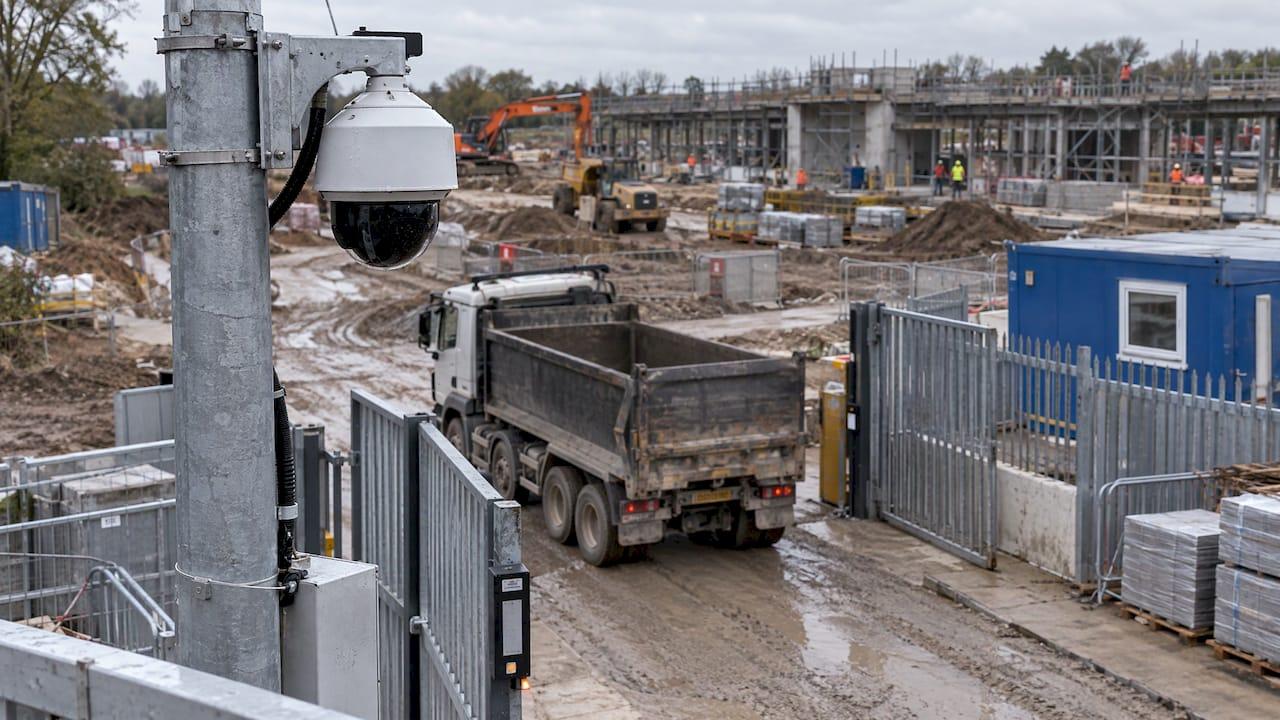
Construction site CCTV works when it is designed around the site: cameras placed for recognition-quality images, lit properly at night, powered reliably, and watched by someone who can act. A camera on a pole that only records is evidence after the loss. A monitored system, joined up with lighting, fencing and access control, is what stops many incidents before they cost you plant, copper or programme time.
This guide is for site managers, contractors and developers in Liverpool and the North West who need to specify or compare systems. It covers what to install, how to plan coverage, what the guidance says about recording and monitoring, and what to check before you hire an installer.
TL;DR
- Around three quarters of UK construction sites already use CCTV of some sort, according to Construction Briefing, so the question is how well it is designed, not whether to have it.
- Cameras need overlapping coverage, recognition-quality images at night and lighting that suits them. Police-backed guidance says CCTV is a good deterrent only when installed and used correctly.
- Live monitoring with a defined response beats recording alone. Plan for 31 days of storage if you want footage usable for prosecution.
- CCTV works best alongside fencing, lighting, access control and a named person who can operate the system.
- Choose an installer certified by SSAIB or NSI to BS8418, so the service is independently inspected.
Table of Contents
- Why building sites need more than a camera on a pole
- What CCTV can and cannot do on a construction site
- Types of construction site CCTV
- How to plan coverage, lighting and power
- Recording, storage and who runs the system
- Monitored versus recorded-only CCTV
- Build CCTV into a wider site security plan
- The legal side: signs, purpose and data protection
- What to look for in a CCTV installer
- Our view on construction site CCTV
- Talk to us about your site
- FAQ
- Sources
Why building sites need more than a camera on a pole
Sites are attractive because they hold valuable, portable kit in a place that changes every week. Project Plant reported in April 2026 that an estimated £800 million to £1 billion was lost by construction firms to on-site theft in 2025, with some experts suggesting the true figure could be two or three times higher because of under-reporting. The same article states that 92% of construction firms confirmed they had experienced site theft that year, and that many UK sites remain light on CCTV and over-reliant on conventional security.
Theft is not the only problem. Vandalism, arson, trespass and unauthorised vehicle entry all happen out of hours, when nobody is there to see them. Footage also settles disputes: who was on site, which delivery arrived when, whether a gate was left open.
The National Building Crime Centre guidance, written for police and the industry, says CCTV on a construction site is a good deterrent provided it is used and installed correctly. That condition is the whole job. The rest of this article is about meeting it.

What CCTV can and cannot do on a construction site
Be clear about the role of cameras before you buy. The NPSA states that CCTV will not prevent criminal action by itself but may deter or detect it, and should always be used alongside other security measures as one coordinated solution.
In practice that means cameras do three jobs:
- Deter. Visible cameras and signs make a site look like harder work than the one next door. The CCS Best Practice guide says CCTV, together with appropriate signage, can provide a good deterrent to intruders.
- Detect. Cameras linked to detection and alerts tell someone something is happening while it is happening.
- Evidence. Recorded footage supports police enquiries, insurance claims and internal disputes.
If you only get the third job, you have bought a record of your loss. Monitored systems that bring in a human operator and a response plan cover all three.
Types of construction site CCTV
The right type depends on how long the project runs, whether mains power exists and how the site layout will change.
Fixed, wired cameras
On longer projects, or sites with a permanent compound, fixed cameras on a secure mains supply give the most reliable picture and the lowest running cost per camera. They suit new-build phases where the site boundary stays put and where you can run cable to a central recorder in a locked cabin.
Wireless and portable systems
The CCS guide notes that portable CCTV systems are available and can be moved easily as the site progresses. That matters because a camera covering the front gate in week two may be pointing at a stack of scaffold boards in week twenty. Wireless links between cameras and a recorder avoid trenching cable across ground that will be dug up again.
Power-independent systems
The NBCC building site guidance says mobile CCTV that operates independently of site power is a good solution for sites with no power at all. The CITS Theft Guide adds that sites increasingly use rapid-build, solar or battery-powered surveillance towers with remote monitoring, which can be redeployed as the site footprint changes.

Number plate recognition
The CCS guide suggests larger sites may benefit from an ANPR enhancement to manage vehicles and flag unauthorised ones trying to enter. If you also want to know where plant and trailers go once they leave the gate, small equipment GPS tracking can complement camera coverage on the assets themselves.
AI and health and safety use
Construction Briefing reports that only around five percent of UK sites use CCTV for health and safety, while camera suppliers say AI-enabled analysis could help stop accidents and check that procedures are followed. If you are specifying a system now, ask for one that could be extended this way later, so the cameras you install do not need replacing.
How to plan coverage, lighting and power
Most failed installations fail at the planning stage. These are the points to settle before a single camera goes up.
Walk the site and map the weak points
The CCS guide says a CCTV system should be designed to cover vulnerable areas at relevant times. Start with the perimeter, gates, site entrance, material stores, the plant compound and any spot where fencing is thin or hidden from the road. Then think about where thieves would carry heavy items out, because cameras that see the approach and exit routes give you better images than cameras aimed at the stores door alone.
Overlap the cameras
For perimeter protection, the NPSA states that fixed-view cameras should overlap in a heel-to-toe configuration with no gaps. A blind spot between two cameras is exactly where an intruder will walk. The NPSA also calls for perimeter lighting of uniform height and spacing with a minimum light level of three lux.
Aim for recognition, not just detection
Both the NBCC and CCS guidance say cameras should be positioned to achieve recognition-quality images without site lighting interfering with picture quality. A wide shot that shows a figure in the yard is detection. A face, a number plate or a distinctive jacket you could identify later is recognition. Glare from floodlights pointed straight at a lens will undo the whole picture, so camera and lighting positions are planned together. The CCS guide says CCTV design should be coordinated with the lighting system so that light quality supports it.
Plan for the dark
Most incidents happen out of hours. The CCS guide advises infra-red technology to record night-time activity. It also says that in high-crime areas cameras may need vandal-resistant housings, and on a site with public footpaths or a history of trouble that is cheaper than replacing damaged units.
Decide power and connectivity early
Wired mains supply, battery, solar or generator: each has trade-offs on running cost, runtime in winter and how easily it moves. Remote monitoring needs a reliable data connection too, so check mobile signal at the compound before you decide. A system that loses power or connection overnight is a system that is not watching.
Protect the recorder
Keep recording equipment in a locked, secure location, not in an unlocked cabin by the gate. If the recorder walks, so does the evidence.
Recording, storage and who runs the system
If footage may be used for prosecution, the CCS Best Practice guide states the system should have a recording and storage capability of 31 days, in a format acceptable to the police for evidential purposes. Thirty-one days covers a long weekend plus the time it takes to discover a loss and report it.
The same guide says that, to prevent police investigations being hindered, a member of staff who knows how to operate the system must be available at all times. Name that person in the site set-up, give them a deputy and make sure they can export clips quickly. Footage nobody can retrieve is worth nothing.
Monitored versus recorded-only CCTV
The NPSA advises that CCTV cameras should be monitored live by an operator in a security control room, where footage can also be recorded for evidence. The difference in outcome is simple:
| Recorded only | Remotely monitored | |
|---|---|---|
| When you find out | After the loss, usually next morning | While it is happening |
| Main benefit | Evidence | Deterrence, early response and evidence |
| Who acts | You, after reviewing footage | An operator, who follows an agreed response |
| Best for | Low-risk, short projects | Sites with plant, copper, fuel or a history of incidents |
Good lighting matters here too: the NPSA notes that it enables a response team to operate if an intruder is found or an alarm is raised. Agree the escalation chain before the system goes live: who is called first, who attends, and when the police are contacted.
We cover how off-site monitoring works in more detail on our CCTV and remote monitoring page.
Build CCTV into a wider site security plan
Cameras are one layer. The NPSA says CCTV should always sit alongside other measures, and the CCS guide points the same way. A sensible layered plan for a building site includes:
- Perimeter: robust hoarding or fencing, with locked gates and no easy climbing aids stacked against them.
- Lighting: coordinated with camera positions, as above.
- Access control: the CITS guide notes that access control directly supports compliance with CDM Regulation 13(4)(b) on reducing access by unauthorised persons. Our access control installations can manage who enters gates, cabins and stores.
- Alarms: intruder alarms in site cabins and secure stores add a second layer where the building allows it.
- Secure storage: lock tools and materials away; do not rely on cameras to protect what is left in the open.
- People and process: key control, visitor logs and a named responsible person.
The CITS guide also notes that criminal groups have adopted drones for reconnaissance, so any drone capability should be matched by counter-reconnaissance awareness among the workforce. A simple instruction to report unfamiliar people photographing the site, or vehicles that keep returning, costs nothing.
The legal side: signs, purpose and data protection
If your cameras capture people, they capture personal data. The Home Office Surveillance Camera Code of Practice sets out 12 guiding principles, including a specified legitimate purpose and pressing need, consideration of the effect on privacy, transparency, and restricted access to retained images.
For a site manager, that translates into habits:
- Write down why each camera is there, for example theft and trespass at the compound.
- Put up clear signs at entrances saying CCTV is in use.
- Point cameras at the site, and avoid covering neighbouring homes or public areas more than needed.
- Restrict who can view and export footage.
- Do not keep images longer than you have a reason to, while meeting the 31-day recommendation if you want them usable for prosecution.
For questions about your specific obligations as a data controller, speak to your company's data protection lead or take advice from a qualified adviser.
What to look for in a CCTV installer
The CITS Theft Guide recommends that CCTV providers should ideally be members of SSAIB or NSI and certified to BS8418 requirements, so the provider is inspected by a UKAS-certified inspectorate and the service meets a minimum standard. Use that as your first filter, then ask:
- Who designs the system, and who installs it? The person who surveys the site should be accountable for the result.
- Is the quotation fixed and clear? You should know what is included before work starts.
- Can the system be moved or extended? Sites change; the system should too.
- How is it monitored, and what happens on an alert? Ask for the response process in writing.
- What is the aftercare? Cameras get knocked, cables get cut and lenses get dirty. Find out who comes out and how fast.
- Will the footage stand up? Check storage capacity, image quality at night and export formats.
Our view on construction site CCTV
Most of the sites we are asked to look at already have cameras. What they lack is a design. Cameras have gone up where there happened to be a pole, the night picture is poor because floodlights shine into the lens, and nobody on the team knows how to pull a clip.
We specify, install and SSAIB-certify every system with the same engineer, with no salespeople and no subcontractors. That means the person who walks your site and decides where the cameras go is the person who fits them and answers for them afterwards. You get a clear fixed quotation, a tidy installation and aftercare, including 24-hour support.
Our approach is to treat CCTV as part of a layered plan: cameras, lighting, access control and alarms working together, with remote monitoring so someone is watching when the site is empty. We have done this for temporary site compounds as well as permanent premises, and we design so the system can follow your project as it develops.
Freddie
Talk to us about your site
We design and install CCTV, access control and intruder alarms for construction and commercial sites across Liverpool and the North West. Every job starts with a site survey and ends with a fixed quotation, so you know what you are getting before you commit.

See how we approach building work on our construction sector page, look at a temporary site compound CCTV case study, or check our SSAIB and other accreditations. We cover Liverpool, Warrington and Wigan, plus the wider region. When you are ready, contact us through our main site to arrange a survey. If your project also includes completed homes, we can look after home security once they are handed over.
FAQ
Do construction sites have CCTV?
Most do. Construction Briefing reports that around three quarters of UK construction sites use CCTV of some sort for security. Only around five percent use it for health and safety, so there is room for sites to get more from the cameras they already have.
What is the best CCTV camera for a construction site?
There is no single best model; it depends on the site. Look for cameras that deliver recognition-quality images, work at night with infra-red, and sit in vandal-resistant housings where the risk is high. Then choose fixed, wireless or power-independent systems based on how long the project runs and whether mains power exists.
How long should construction site CCTV footage be stored?
The CCS Best Practice guide says that if the system is intended for prosecution it should record and store for 31 days, in a format acceptable to the police. Keep the recorder in a secure location and make sure a named person can export clips.
Is CCTV on its own enough to secure a building site?
No. The NPSA says CCTV may deter or detect crime but will not prevent it, and should be used with other measures. Pair cameras with lighting, secure fencing, access control, secure storage and live monitoring so that someone can respond when an alert comes in.
What laws apply to CCTV on construction sites?
The Home Office Surveillance Camera Code of Practice sets 12 guiding principles, including a legitimate purpose, respect for privacy, transparency and restricted access to retained images. In practice that means signs, clear reasons for each camera and controlled access to footage.
Sources
- Big Brother wants you to wear your hard hat, Construction Briefing
- Tool theft: the hidden losses hitting UK firms, Project Plant
- Construction Site Security Guidance, National Building Crime Centre
- Building Site Security, National Building Crime Centre
- CCTV guidance, NPSA
- Construction Site Security, CCS Best Practice Guide 2021
- CITS Theft Guide
- Surveillance Camera Code of Practice, Home Office