
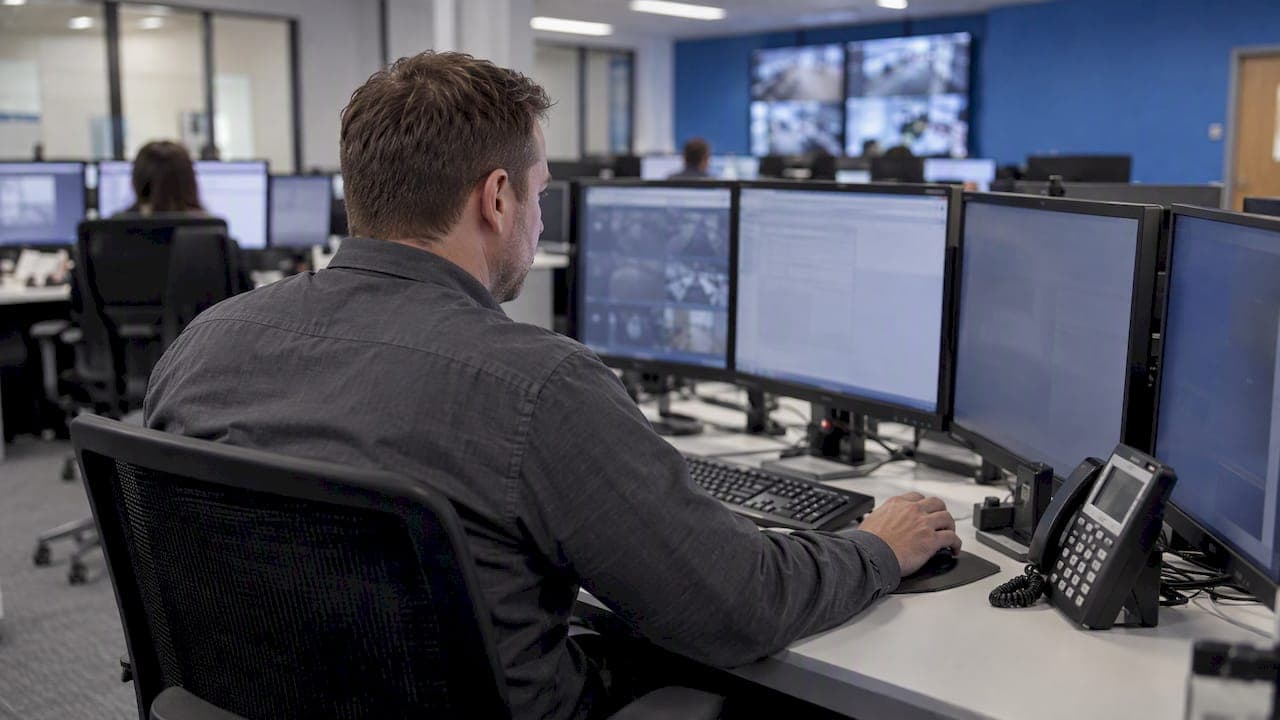
Remote security monitoring means your alarm, CCTV or access control system sends its signals to a staffed monitoring centre, or to your phone, instead of relying on someone being on site. A trained operator can check what has happened and call the keyholder or, for qualifying systems, the police. Whether you get a police response depends on how the system is installed, who certifies it and how it signals. Those details matter more than the number of cameras.
TL;DR
- Remote monitoring links your intruder alarm and CCTV to a manned alarm receiving centre (ARC) that assesses signals around the clock.
- Police response is not automatic. Your installer and monitoring company need certification from a UKAS-accredited body such as SSAIB or NSI, and the system needs a police URN.
- Without a URN, an activation is treated as Type B and police generally attend only when there is evidence of an offence in progress.
- Home, school, church and building site monitoring differ in risk, hours and alert rules, so the design should start from a site survey.
- Ask about the signalling path, battery backup and servicing before you sign, because a monitored system is only as strong as its weakest link.
Table of Contents
- What remote security monitoring actually is
- How a remote-monitored system works, step by step
- Police response: the part most buyers miss
- Types of remote monitoring
- Home versus business, school, church and building site
- Benefits and limits compared with on-site guarding
- How reliable is it? Internet, power and signalling
- Our perspective: design it round the response
- What to check before you buy
- Remote monitoring with Impact Security Systems
- FAQ
- Sources
What remote security monitoring actually is
There are two things people mean by the phrase, and they overlap.
Monitored alarms. Your intruder alarm signals an alarm receiving centre when it trips. The BSIA describes an ARC as a secure facility where alarm signals from intruder alarms, CCTV and fire alarms are received and assessed by trained operators.
Remote video and app access. Cameras and alarm panels connect to the internet so you, or a monitoring operator, can see live images, receive alerts and arm or disarm the system from anywhere.
Most good systems combine both. You get an app for day-to-day control, and a professional on the other end when something happens while you are asleep, on holiday or locked out of the building.
The distinction matters because an app notification on its own puts the decision on you. If your phone is on silent at 3am, nothing happens. A monitored system puts a second pair of eyes between the sensor and the outcome.
How a remote-monitored system works, step by step
- Detection. A door contact, motion detector, glass-break sensor or camera analytic registers something unusual.
- Signalling. The control panel sends a coded message through its communicator to the ARC. Better systems use two separate routes (see the section on reliability below).
- Assessment. An operator receives the signal, checks the site history and, where video is connected, looks at the images. According to FMJ's overview of surveillance standards, a Remote Video Response Centre operator can check whether an incident is a genuine breach and pass verified incidents to the police for an immediate manned response.
- Action. The operator contacts keyholders, can speak to an intruder through a site speaker where one is fitted, or requests police attendance if the system qualifies.
- Record. The event is logged, which helps with insurance claims and with spotting patterns such as repeated false alarms from one sensor.
The value is in step 3. Most alarm activations are not break-ins. A human who can verify what is happening saves the police a wasted journey and saves you a call-out fee or a fine for repeated false alarms.
Police response: the part most buyers miss
This is where remote monitoring either pays off or does not. In England, police response to alarms follows national guidance from the National Police Chiefs' Council. A force policy summarising it states that to be eligible, installation, maintenance and monitoring companies must be certified by a UKAS-accredited inspectorate body, such as NSI or SSAIB, and appear on the compliant list held by the local police force.
Qualifying systems are issued a unique reference number (URN). The same document explains that without a URN, activations are Type B and police need evidence of an offence in progress before responding.
West Yorkshire Police's published policy sets out the practical difference. A planned police response goes to Type A accredited systems, while Type B systems generally do not receive one, although additional information such as a witness report or verified video may prompt an emergency response. The same policy describes Type A systems as those with an accredited device that terminate at an ARC. Policies vary slightly between forces, so the force covering your property is the final word.

In plain terms: a loud siren and a phone notification do not bring the police. A certified, URN-registered system monitored by an ARC can.
Types of remote monitoring
| Type | What is monitored | Who responds | Typical fit |
|---|---|---|---|
| Alarm signal monitoring | Intruder, panic and fault signals from the alarm panel | ARC operator, keyholders, police (with URN) | Homes, offices, shops, churches |
| Remote video monitoring | Camera events and live images, often verified by an operator | Monitoring operator, then police or keyholder | Commercial sites, yards, car parks |
| Self-monitoring via app | Alerts and live view sent to your phone | You | Low-risk homes, secondary monitoring |
| Access control monitoring | Door events, forced doors, held-open alarms | Site staff, operator | Schools, offices, multi-tenant buildings |
| Lone worker and out-of-hours | Staff check-ins, panic buttons | Control room | Care, retail, facilities teams |
They are not mutually exclusive. A school might have a monitored intruder alarm, app-controlled access and CCTV that staff can review after an incident. A haulage yard might add camera-based detection so the operator sees an intruder before the perimeter alarm sounds.
Home versus business, school, church and building site
The technology is shared, but the design is not.
Homes
A home system is usually about the hours when nobody is in or everybody is asleep. Door and window contacts, motion detection that ignores pets, and a keypad or app that is easy for the whole household. Doorbell cameras and intercoms add visibility at the front door. The best home setups keep the app simple and the monitoring behind it dependable. Our home security page covers burglar alarms, home CCTV, smart doorbells and smart home integration.
Shops, offices and commercial premises
Businesses care about out-of-hours break-ins, but also about staff access, stock and insurance conditions. Intruder alarm design, camera coverage and door control need to fit together. See an example of a compact office alarm installation and our commercial intruder alarm service.
Schools and nurseries
Here the priorities shift: controlled entry during the day, visitor management, intercoms at reception and a plan for emergencies. Out-of-hours monitoring still matters because school buildings are empty for long stretches in the evenings, weekends and holidays. Lockdown systems add another layer, letting staff trigger a building-wide alert quickly.
Places of worship and community buildings
These buildings are often open to the public at unusual hours, have valuable fixtures and are run by volunteers who cannot be expected to manage a complicated system. Simple arming, clear alerts and a keyholder list that is easy to update are the practical needs. Our leisure and public sector page covers this kind of premises.
Construction and temporary sites
Building sites are targeted for plant, tools and materials, and the perimeter changes every few weeks. Wireless or relocatable cameras with remote monitoring suit that. Read how we secured a temporary construction compound with CCTV and see our construction sector page.
Rural and remote sites
Farms, yards and depots may have poor mobile signal and long distances between buildings. Point-to-point wireless links and carefully placed cameras solve what a standard off-the-shelf kit cannot. One example is a haulage and agricultural CCTV system using wireless links.
Benefits and limits compared with on-site guarding
Benefits
- Cost. A staffed guard on every site is expensive, whereas one monitoring centre watches many sites at once.
- Always on. Signals are assessed day and night, including bank holidays.
- Verification. Video lets an operator confirm a breach before escalating, which reduces false alarms.
- Evidence. Recorded footage and event logs help with police reports and insurers.
- Flexibility. You can check the site from your phone and change user codes without a visit.
Limits
- A person is not on site. Remote monitoring detects and escalates. It does not physically stop someone entering. Response times depend on keyholders or police.
- Dependence on communications. If the signalling path fails, the monitoring is blind. Good design reduces this risk but cannot remove it.
- Setup quality. Poorly positioned cameras or badly configured sensors create false alerts, and operators become less effective.
- Ongoing cost. Monitoring, servicing and SIM or broadband costs recur, so ask for the total, not just installation.
For most premises, remote monitoring is not a replacement for good physical security. Locks, lighting, fencing and access control still do the first job of deterrence. Monitoring does the second: making sure someone knows quickly when deterrence fails.
How reliable is it? Internet, power and signalling
The question we hear most from cautious customers is what happens when the internet or power goes down.
Signalling path. The link between your panel and the ARC is called the alarm transmission system. A single-path system uses one route. As BIBA's guidance for purchasers explains, a fault or criminal act on that path can delay or prevent a signal reaching the ARC, so insurers generally recommend dual-path systems, where the second path carries on if the first is lost. The same guidance notes that if one path is lost and the other follows shortly after, the ARC may be permitted to call for a police response.

Copper line switch-off. BIBA also warns that older digital communicators relying on the traditional telephone network may not work properly on the move to all-IP networks, and may need upgrading, typically to an IP plus mobile dual-path unit. If your alarm still dials out over a landline, ask your engineer to check it.
Power. Alarm panels have a backup battery, and cameras and recorders can be fitted with uninterruptible power supplies. The battery should be tested at each service. A battery that has quietly degraded is one of the commonest reasons a system fails when it is needed.
Cyber security. Anything connected to the internet needs strong, unique passwords, up-to-date firmware and sensible network design. Keeping cameras and recorders on a separate network segment from your general Wi-Fi is good practice, and it is one reason we install networking as well as security.
Servicing. Reliability is maintained, not bought once. An annual service checks sensors, batteries, communicators and the signalling test with the ARC.
Our perspective: design it round the response
We approach remote monitoring backwards. Before talking about cameras, we ask what should happen in the first five minutes after something goes wrong, and who needs to be doing it.
If the answer is that police should attend, the whole system has to be built to qualify: an SSAIB-certified installation, a URN, a monitored signalling path and a maintenance schedule that keeps it valid. If the answer is that the site manager should look at the video and decide, the focus shifts to camera placement, app reliability and clear alerts.
The same engineer surveys, designs, installs and certifies the system. There are no salespeople and no subcontractors in between, so the person who specified the system is the person who stands behind it. That matters most with monitoring, because small decisions at installation, such as where a detector is mounted or how a communicator is configured, decide how well the system performs years later.
We also keep the user in mind. A school office, a church warden or a busy homeowner will not read a manual. If the system is awkward, it gets left unset, and no monitoring contract fixes that.
— User
What to check before you buy
- Certification. Is the installer certified by a UKAS-accredited body such as SSAIB or NSI? You can see our accreditations. Ask for the certificate, not just a logo.
- Police response. Will the system be registered for a URN, and who manages that? What happens to the URN if you do not keep up maintenance?
- Signalling. Is the communicator dual path? Is it compatible with the move away from analogue phone lines?
- Monitoring arrangement. Who receives signals, what are the operators instructed to do and who is on your keyholder list?
- Video. Is video linked to alarm events, and who can view it? Can footage be exported for the police and your insurer?
- Insurance. Does your insurer specify a standard or certification for the alarm? Tell them about any change.
- Installer. Who actually does the work? Direct engineers are accountable in a way that layered subcontracting is not.
- Fixed quote. Ask for equipment, installation, monitoring and servicing priced separately, with no vague allowances.
- Aftercare. What is the callout arrangement, and is there a genuine out-of-hours number?
- Takeover. If you already have an alarm, can it be taken over or does it need replacing?
Remote monitoring with Impact Security Systems
We design, install and SSAIB-certify intruder alarms, CCTV, access control, intercoms and networking for homes, schools, places of worship and commercial premises across Liverpool and the North West. Remote monitoring and app control are part of the design, and we offer police-response monitored systems, annual servicing, 24-hour callout and takeovers of existing systems.

If you want to see how it would work for your property, start with our CCTV and remote monitoring service or our page on service and maintenance. We survey the site, then give you a clear fixed quotation.
FAQ
Is remote security monitoring worth it for a home?
It is if nobody is regularly in the house, if you travel or if you want a professional to act on alerts you might miss. For a homeowner at home most of the day, an app-controlled alarm with good sensors may be enough. A monitored system with a URN is the route to police response.
Will the police always attend a monitored alarm?
No. Police response applies to qualifying systems, installed and maintained by certified companies and registered with a URN. Even then, forces can adjust their policy, so check with your installer and local force. Without a URN, police generally need evidence that an offence is in progress.
What happens if my broadband goes down?
On a well-designed system, the alarm signals over a second route such as a mobile network, so monitoring continues. A single-path system may go blind until the fault is noticed. Ask your installer whether your communicator is dual path.
Can I add remote monitoring to an existing alarm or CCTV system?
Often yes, depending on the age and make of the equipment. A survey will show whether the panel can take a modern communicator or whether parts need replacing. We also take over existing systems and bring them into maintenance.
Is remote monitoring the same as having a CCTV app?
No. An app lets you look at cameras and receive alerts, but you are the one responding. Remote monitoring adds a staffed centre that assesses signals and acts on them.
Sources
- BSIA: Alarm Receiving Centres
- FMJ: Surveillance standards
- NPCC requirements for police response to security systems
- West Yorkshire Police: Alarms force policy
- BIBA: Intruder alarms guidance for purchasers