
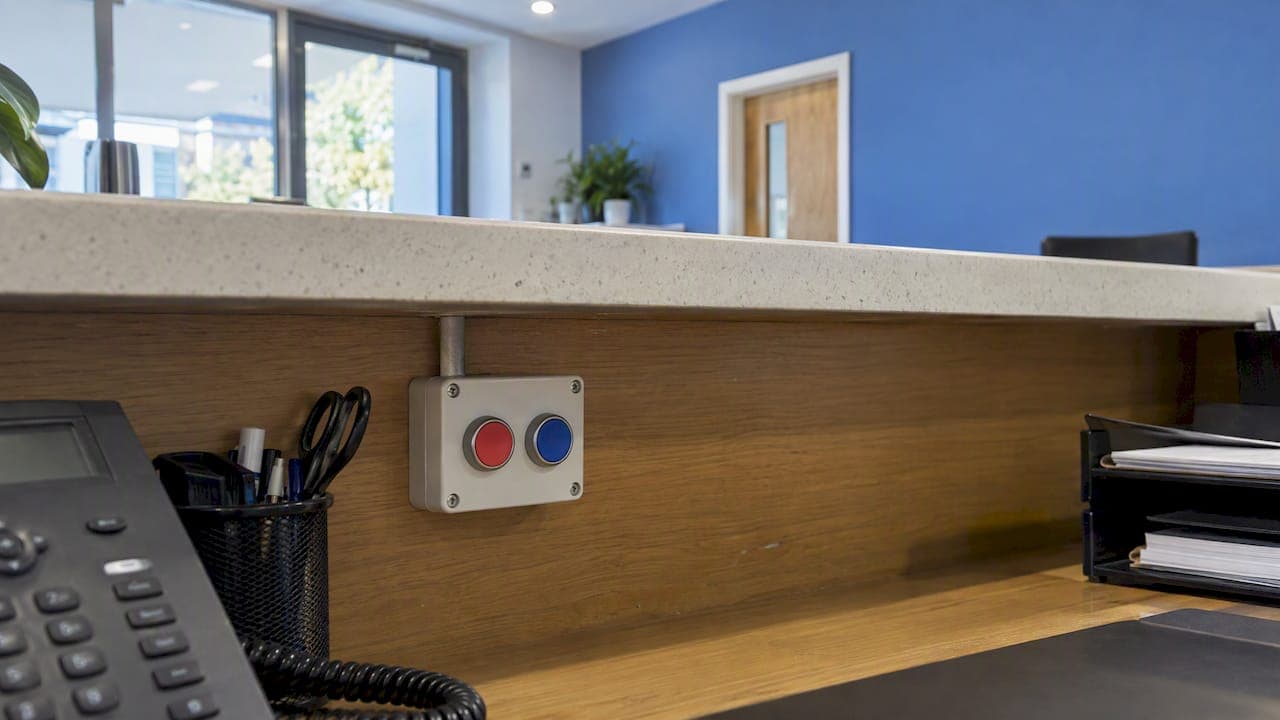
A panic alarm system lets someone raise the alarm with one press, either loudly on site or silently to a monitoring centre. What happens next depends on how it is wired, who monitors it and whether it meets police requirements. For a home, school, nursery, place of worship or business, the right choice is usually a monitored system fitted by an accredited installer, with buttons placed where people actually stand when trouble starts.
This guide explains the types, what happens after a press, which UK standards apply, and how to choose and place buttons for your property.
TL;DR
- A panic alarm system is a button or fob linked to a siren, a monitoring centre or both. Silent, monitored systems are the ones that bring a response to the building.
- Audible-only alarms depend on someone nearby hearing them. Monitored systems send the signal to a manned alarm receiving centre.
- Police response needs a Unique Reference Number (URN), an accredited installer and a system built to the relevant standards. It is never guaranteed.
- Place buttons at reception, at tills, near entrances and in bedrooms, then test them. Annual servicing keeps the system dependable.
- Video intercoms and CCTV make a panic system more useful because they show who is at the door and what is happening.
Table of Contents
- What a panic alarm system is and how a button summons help
- Audible, silent, wireless and monitored: the differences
- What happens when a panic alarm is activated
- UK standards and what police response requires
- Where to put panic buttons
- How video intercoms and CCTV work with panic alarms
- Our perspective
- Keeping the system dependable
- Get a panic alarm designed for your property
- FAQ
- Sources
What a panic alarm system is and how a button summons help
A panic alarm is a device you press to ask for help when people or property are in danger. The button can be fixed to a wall, hidden under a desk or counter, or carried as a small wireless fob. Pressing it sends a signal to the alarm control panel, and the panel decides what to do: sound a siren, flash a strobe, send a message to keyholders, or pass the signal to a monitoring centre.
Three parts matter:
- The trigger. A fixed button, a pendant, a wireless fob or a pull cord. Business devices are often dual-button, so two buttons must be pressed together. That reduces accidental activations.
- The control panel. This receives the trigger and carries out the response you have set.
- The signalling route. A siren on the wall, a phone line or broadband connection, or a mobile (GSM) link to a monitoring centre.
Terms vary. Installers may say hold-up alarm, personal attack alarm or duress alarm for the same idea. If you are comparing quotes, ask each installer to describe what happens from the moment of the press to the moment someone arrives. The answer tells you more than the product name.
Audible, silent, wireless and monitored: the differences
These words describe different things, and most real systems combine them. Audible and silent describe what happens at the premises. Wireless describes how the button talks to the panel. Monitored describes who receives the alert.
| Type | What happens on a press | Best suited to | Main consideration |
|---|---|---|---|
| Audible | Siren or strobe sounds on site | Deterring an intruder, alerting people nearby | Relies on someone hearing it and acting |
| Silent | No sound at the premises; alert goes to a keyholder or monitoring centre | Reception desks, shops, offices where noise could escalate a situation | Needs a reliable signalling route |
| Wireless | Fob or button sends a radio signal to the panel | Moving staff, bedrooms, retrofit jobs | Battery checks and range testing |
| GSM or dual-path | Signal travels over mobile network, often as a back-up to the phone or broadband line | Sites where the line could fail or be cut | Signal strength on site |
| Monitored | Signal goes to a manned alarm receiving centre (ARC) that follows your agreed action plan | Schools, businesses, anyone wanting a managed response | Ongoing monitoring contract |
The BIBA guidance for purchasers draws the key line: audible-only systems rely on somebody nearby hearing the siren and taking suitable action, while monitored systems transmit signals to a continuously manned ARC. If your building is empty overnight, or in a quiet street, that difference decides whether a press leads to anyone doing anything.
On mobile links, SSAIB explains that some dual-path systems use GSM mobile-phone technology to send the alarm signal when the digital communicator cannot. For a panic button, that second route matters, because a failed line should never mean a silent failure.
The NHS describes the same split for personal alarms. NHS guidance on personal alarms says monitored alarms connect to a 24-hour monitoring service, while basic alarms make a loud local noise. It also notes that personal alarms can alert a call centre, family member or carer, including when the person is outside the home.
What happens when a panic alarm is activated
The sequence depends on the system, but a monitored one usually runs like this:
- Someone presses the button or fob.
- The panel sends the signal to the ARC, with the site and the type of alarm.
- An operator follows the action plan agreed with you. That can mean calling the premises, calling keyholders, requesting police, or all three.
- Police, keyholders or both attend.
The College of Policing records a UK example in which pressing a two-button handheld fob generated an alert with the victim's location and case details, created a computer-aided-dispatch reference and led to an immediate-grade police unit being sent. That is the best case: a clear trigger, a clear location and a recognised route to the police.
Two points are worth understanding before you buy.
Confirmation. Police forces do not treat every alarm signal as a call for attendance. BS 8243 sets out confirmation rules for intruder systems, according to BIBA. A dedicated, deliberate hold-up trigger, such as a dual-button device, is designed for situations where a person is in danger, which is why it is treated differently from a single sensor detecting movement.
No guarantee. SSAIB cautions that monitoring does not guarantee a police response. Notification depends on confirmation and on police requirements, and a police-issued URN can be withdrawn after repeated false alarms. In practice, that means two things: train everyone who might press the button, and keep a reliable list of keyholders. Keyholder availability and response times are part of how a site holds up when police are not sent, and site access management is worth thinking through for any premises with several staff or contractors holding keys or codes.
UK standards and what police response requires
If you want police to attend, the system has to be set up properly from the start. The requirements are not complicated, but they cannot be bolted on afterwards.
- Accredited installer. Panic alarm systems intended for police response must be installed and maintained by companies accredited by the NSI or SSAIB. These bodies certify the installing company, not just the equipment.
- Standards. The same guidance lists BS EN 50131-1:2006+A3:2020, PD 6662:2017 and BS 8243:2021 among the standards UK intruder alarms should conform to.
- A URN. BIBA states that police response requires a Unique Reference Number, and that a system conforming to PD 6662 is vital to obtain one.
- Maintenance. The Collections Trust guidance advises servicing annually, or every six months where the system is ARC-linked for police response.
If an installer tells you a system "will get the police" without mentioning accreditation, a URN or standards, ask them to show you how. Our accreditations page sets out our own certification.
Your insurer may also have requirements for alarms and monitoring, so check your policy wording before you specify a system.
Where to put panic buttons
Placement is where most systems succeed or fail. A button nobody can reach during an incident is no use. Walk the building and imagine the moments when someone needs help, then ask where that person would be standing.
Homes
The sensible spots are the bedroom, the hallway near the front door and the main living area. Wireless fobs and pendants suit homes because they move with you. A button that sits by the bed is useful at night, when most people are least able to reach a phone. Link the system to monitoring so the press reaches a person, not only a siren. Our home security page covers burglar alarms, home CCTV and smart doorbells and intercoms that can sit alongside.
Schools and nurseries
Staff need to be able to raise an alert from reception, the office, the front gate or door entry point, and from classrooms or play areas as the risk assessment suggests. Official counter-terrorism advice for schools says access control systems should come with documentation, log books and service schedules, and staff should be trained in operating them. The same advice recommends a challenge culture, clear separation of public and private areas, and visitor sign-in with access controls. A panic system does its best work inside that setup. We also design lockdown systems for schools and event centres.
Places of worship
Buildings open to the public at odd hours, often with volunteers on their own, have a particular risk. Think about the main entrance, the vestry or office, and any room where cash or valuables are kept. Pendants for the person unlocking up or locking up are practical. Quiet silent alerts avoid causing alarm among a congregation or visitors.
Shops, offices and other businesses
Tills, reception counters, back offices and cash-handling areas are the usual places. Fixed dual-button devices under the counter suit staff who stand in one place. Wireless fobs suit people who move around, such as managers or lone workers. Warehouses and larger sites often add sirens and strobes so people in noisy or distant areas know to act. Read more about our commercial intruder alarms.
Testing and training
Whatever the property, test every button on a schedule, and agree a plain rule for when to press. Repeated false alarms can cost you a police URN, so people must know how the button works, including the second press on a dual-button device.
How video intercoms and CCTV work with panic alarms
A panic button tells you someone needs help. Video and access control tell you where, who and what is happening.
- Video intercom. Staff can see a visitor before opening the door. For nurseries, schools and shared buildings, that is often the first line of defence, and the panic button is the fallback if someone does get through. See our intercom systems.
- Access control. Doors lock and unlock by card, fob or code, with a record of who went where. It supports the challenge culture and visitor controls that school guidance describes. See access control and door entry.
- CCTV. Cameras let a monitoring operator or keyholder check an incident remotely. See CCTV and remote monitoring.
Official school guidance says security systems such as intruder alarms, CCTV and lighting should be integrated so they work together in a coordinated way. The Collections Trust guidance likewise notes that an integrated approach can connect alarms with CCTV and access control for a coordinated response. Done well, it means one design, one set of records and one engineer who knows how it all fits.
Our perspective
Most panic alarm problems we see are not equipment problems. They are design problems: a button in the wrong place, a signal with no reliable route, or a monitoring plan nobody has read since the day it was installed.
That is why we do not send a salesperson to quote and a different team to fit. The engineer who surveys your building specifies the system, installs it and certifies it under SSAIB. They know why every button is where it is, and you can ask them directly.
We would rather talk through who will press the button, in what situation and who needs to respond, than start with a product list. For a school, a nursery, a church or a shop, those answers shape the design more than the brand of fob does.
If you want police response, the system has to be built for it from the first day, with the right standards, accredited installation and a proper maintenance plan. We would also always connect the panic system to video entry or CCTV where the budget allows, because seeing the situation changes how quickly and how well people respond.
Freddie
Keeping the system dependable
A panic alarm is a safety device, and it only helps if it works on the day. Annual servicing is the minimum, and six-monthly visits apply to ARC-linked systems set up for police response, as the guidance above sets out. At each visit, an engineer should test every button and fob, check batteries and signal strength, confirm the signalling path to the monitoring centre and review your keyholder list.
Between visits, do a quick check yourself: press-test with the monitoring centre's agreement, replace fob batteries when warned, and tell your installer when staff, keyholders or building layouts change. Our service and maintenance page covers annual servicing, SSAIB-certified maintenance, police-response monitored systems, 24-hour callout and takeovers of existing systems.

Get a panic alarm designed for your property
We design, install and certify panic and intruder alarm systems, CCTV, access control and intercoms for homes, schools, childcare settings, places of worship and businesses across Liverpool and the North West. Every job is surveyed, installed and SSAIB-certified by the same engineer, with no subcontractors, and quoted at a fixed price.
Start with a site survey and we will tell you what your property needs and how it can connect to monitoring. See our commercial intruder alarm service or get in touch through our home page.

If you already have a system you are not sure about, we can take it over, test it and bring it into a maintenance plan.
FAQ
Does a panic alarm automatically call the police?
Not automatically. A monitored system sends the signal to an alarm receiving centre, and police attendance depends on the system holding a URN and meeting police requirements. SSAIB warns that monitoring does not guarantee a police response. Ask your installer to explain exactly who is called and in what order.
What is the difference between a panic alarm and a hold-up alarm?
The terms are often used for the same thing: a device people press to raise an alarm when in danger. Hold-up or duress alarms are the usual words for business devices, which often need two buttons pressed together to avoid accidents. Panic alarm is a wider phrase that also covers pendants and fobs used at home.
Can I fit a wireless panic button myself?
You can buy basic audible alarms, but they only make a noise. If you want police response, the system has to be installed and maintained by an NSI or SSAIB accredited company, according to UK guidance. A surveyed, certified installation is also easier to insure and service.
How often should a panic alarm be serviced?
At least once a year. Where the system is linked to an ARC for police response, the guidance advises a service every six months. Test the buttons between visits and report any faults straight away.
Can a video intercom work with a panic alarm?
Yes. A video intercom lets staff see who is at the door, and the panic button gives them a way to call for help if a visit goes wrong. Both can be designed as one system, together with CCTV and access control.
Sources
- Intruder Alarms: Guidance for purchasers, BIBA
- Alarm systems, SSAIB
- Panic alarms for domestic abuse victims, College of Policing
- Personal alarms, monitoring systems (telecare) and key safes, NHS
- Intruder alarm systems, Collections Trust (reviewed May 2024)
- Counter Terrorism Protective Security Advice for Schools
- Site Access Management: A UK Guide for Service Teams