
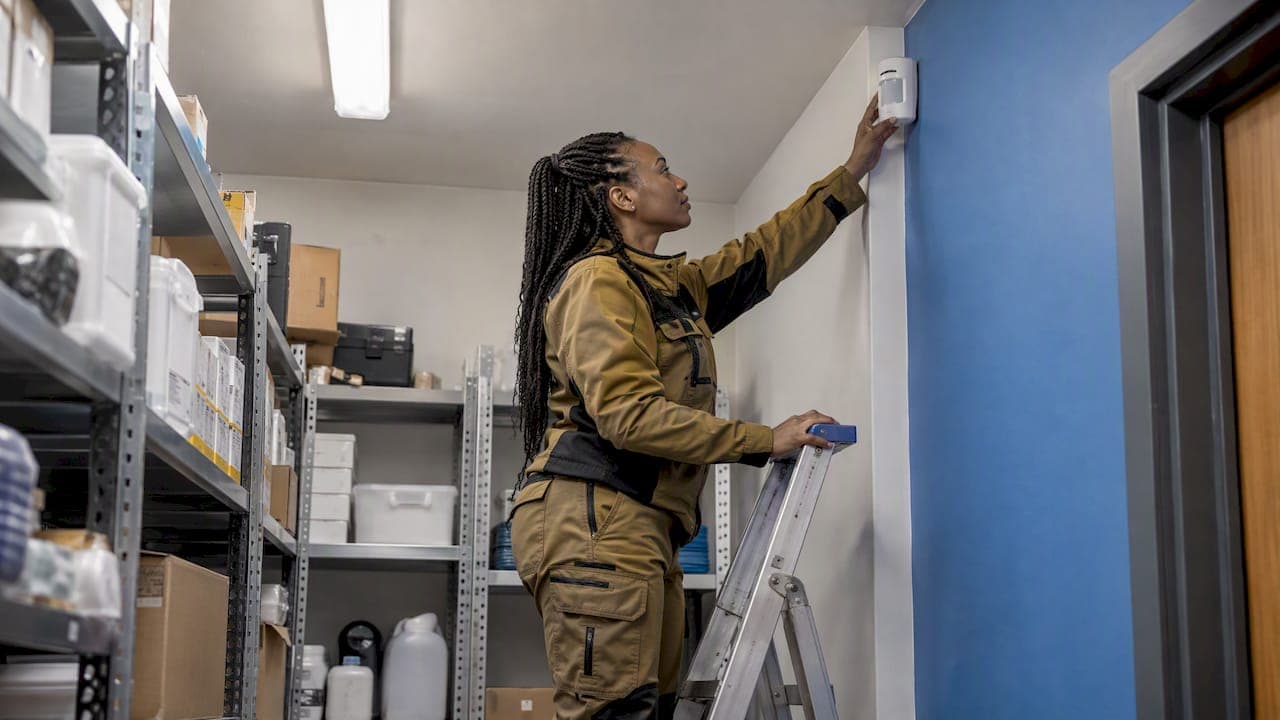
There is no such thing as an "SSAIB approved alarm" in the sense of a box on the shelf. SSAIB certifies the company that designs, installs and maintains your system, not the panel or the sensors. When people search for SSAIB approved alarms, what they usually want is an installer whose work has been independently inspected, so the system is reliable, insurers take it seriously and, for monitored systems, police response stays possible. This guide explains what that means in practice and how to check it before you sign anything.
TL;DR
- SSAIB certification applies to the installer and its business practices, not to individual alarm products.
- A certified installer has been assessed on competence, management, design, installation and inspection of completed work.
- Police response to a monitored intruder alarm needs a Unique Reference Number (URN), and that requires an SSAIB or similarly certified installer and monitoring centre. A URN does not guarantee a response.
- Check the installer on SSAIB's own supplier search, look at which scopes it covers, and ask for a Certificate of Conformity at handover.
- Get a written fixed price and compare roughly three quotes.
Table of Contents
- What SSAIB is
- What SSAIB certification actually covers
- Police response, URNs and monitoring
- Why insurers care
- How it applies to homes, schools, places of worship and businesses
- How to check an installer is genuinely SSAIB certified
- What to ask before you accept a quote
- Our perspective
- Talk to an SSAIB-certified engineer in Liverpool and the North West
- FAQ
- Sources
What SSAIB is
SSAIB stands for the Security Systems and Alarms Inspection Board. It is a certification body for security service providers, covering fire detection, electronic alarm systems, security services, and management and monitoring systems. Its electronic security scheme is broad: intruder alarms for commercial and domestic premises, CCTV, access control, scaffold alarms, vacant-property alarms and lone-worker devices all fall within it.
Many of its schemes are accredited by UKAS, the national accreditation body. SSAIB says this shows it runs its certification in line with the relevant accreditation standards. In plain terms, the people checking installers are themselves checked.
What SSAIB certification actually covers
This is where the search term misleads. Certification applies to the organisation and its business practices, including design, installation, commissioning and maintenance. It verifies that those services, and the systems the company delivers, comply with the relevant standards.
So you cannot judge an alarm by a logo on its keypad. You judge it by who specified it, who fitted it and who will look after it.
How the assessment works
SSAIB's assessment looks at business management, staff competence, system design, installation practices, equipment selection and site inspection of completed installations. That last part matters. Inspectors do not only read paperwork; they look at finished jobs.
Registered organisations must meet criteria suited to the services they provide, and their work must comply with relevant standards or SSAIB Codes of Practice.
What it does not cover
SSAIB is clear that its schemes establish compliance of the security system with the standards relevant to that system. They do not establish compliance with BS 7671 electrical wiring regulations, or the competence of a person installing or testing the building's electrical supply connections. If your alarm needs new mains work, ask who is responsible for that part and what certificate they will give you.
Police response, URNs and monitoring
Most confusion about SSAIB alarms comes from police response, so it is worth being precise.
A bells-only alarm makes noise and relies on neighbours or passers-by. A monitored alarm sends a signal to an alarm receiving centre (ARC), where operators can act on it. If you want police to attend, the system needs a URN. To be eligible, a monitored intruder alarm must be installed by an NSI or SSAIB-certified provider, and the installer and monitoring centre must both be registered with a certification body such as SSAIB. The same guidance is explicit that a URN does not guarantee police response.
For commercial premises the URN is required for police response to security system activations. Policy standards also expect monitored systems to use BS EN 50518-certified ARCs and to comply with PD 6662 and BS EN 50131.
There is a speed element too. The ECHO service automatically passes signals from ARCs to connected police control rooms, which is designed to speed up response. SSAIB also certifies the monitoring side: its monitoring schemes cover Alarm Receiving Centres, Remote Video Response Centres, Secure Operating Centres, stolen-vehicle tracking and lone-worker monitoring, and third-party certification is required where monitoring is meant to lead to an emergency-services response.
The practical rule: if police response matters to you, ask the installer to confirm in writing that your system will be URN-eligible, which ARC will monitor it, and what happens to the URN if you change provider.

Why insurers care
Insurers often insist on a third-party certified provider for security or fire systems, and SSAIB-certified companies carry insurance approval. SSAIB says its certification gives insurers confidence that systems are designed and delivered to a high standard.
The document that proves it is the certificate you receive when the job is finished. A valid SSAIB Certificate of Compliance shows the system meets recognised industry standards and suits the risk grade. Keep it with your policy papers. If you ever claim, or renew with a new insurer, it is the first thing they may ask for.
Before you buy, read your policy or ask your broker what your insurer requires for your property. Requirements differ by insurer and by what you are protecting, so the installer should be able to design to that requirement rather than to a generic package.
An alarm is one layer. For passports, deeds and other small high-value items, a compact electronic lock steel safe adds a second line of defence inside the property, whatever the alarm is doing.
How it applies to homes, schools, places of worship and businesses
The standards behind the certificate are the same, but the right system differs a great deal by building.
Homes
A certified installer should advise on a system appropriate to the property and its grade of risk, not sell a standard kit. A terraced house with a rear alley, a detached home with outbuildings and a new-build with smart-home wiring all need different detector layouts, and different answers on monitoring.
Schools and nurseries
These sites combine out-of-hours burglary risk with a need to control who comes in during the day. Intruder alarms, access control, intercoms and, in some cases, lockdown systems often have to work together. The fire side is a separate discipline: London Fire Brigade notes that addressable systems usually suit larger or higher-risk buildings such as schools. Fire alarm work has its own certification route, and BAFE strongly recommends a third-party certificated provider and says to check which modules (design, installation, commissioning, maintenance) the company holds.
Places of worship
Churches, mosques, temples and community halls are often large, open and sometimes historic, with valuables, lead roofs and long periods of low occupancy. Wiring may be restricted by the fabric of the building. London Fire Brigade points out that wireless systems can suit churches and historic buildings, and the same thinking often applies to intruder detection: the design has to respect the building as well as the risk.
Commercial and construction sites
Offices, warehouses, retail units and sites have the strongest case for a certified, monitored system, because police response and insurance terms are most likely to depend on it. Temporary compounds add another factor: the system has to be quick to deploy and robust outdoors, usually with CCTV and remote monitoring.
How to check an installer is genuinely SSAIB certified
A logo on a van or website is a claim, not proof. Here is a quick way to verify it.
- Use SSAIB's own provider search. SSAIB publishes a directory of registered companies with their contact details and scopes. Search by company name and compare the address and phone number with the quote.
- Ask for the certificate number. SSAIB's supplier schedule verification page shows what a certificate lists. A schedule has an accredited section and an unaccredited one. In a sample verification record, intruder alarm systems to PD 6662:2017 appear under the accredited Schedule A, while visual surveillance and access control sit under the unaccredited Schedule C. That is normal, but it shows why you should read which scopes your installer holds, not just whether it is registered.
- Match the scope to your job. If you want intruder alarms, CCTV and door entry, check each is covered.
- Check the certificate is current. Registration is reassessed, so a certificate that was valid years ago is not enough.
What to ask before you accept a quote
SSAIB's advice for homeowners is simple and sensible: request a written fixed price, ask about call-out or repair cover, contact a range of installers (say three) and compare costs, and obtain a Certificate of Conformity. Add these questions:
- Who will survey the property, and will that same person install it?
- Is any work subcontracted?
- Which grade and standard is the system designed to, and why does that suit my risk or insurer?
- Will it be monitored, by which ARC, and will it be URN-eligible?
- What does annual servicing include, and what does a 24-hour callout involve?
- What certificate will I receive, and when?
- Can I run it from an app, and what happens if the internet is down?
Two quotes can look similar and still differ in what they leave out: detector count, signalling method, monitoring fees, maintenance. A fixed written price with a specification lets you compare like for like.
Our perspective
We have been designing and fitting security systems in Liverpool and the North West for over 20 years, and the most common misunderstanding we meet is that certification is about the equipment. It is not. It is about the people who specify, fit and look after the system.
That is why we work the way we do. Each system is specified, installed and SSAIB-certified by the same experienced engineer. There are no salespeople between you and the person who understands your building, and no subcontractors turning up on the day. If something is not right, you know exactly who is accountable.
Our advice to anyone choosing an installer: ask who will be standing in your hallway or plant room on installation day, and whether that person designed the system. Ask for a fixed quotation, a tidy installation and aftercare that answers the phone, including out of hours. Those are the things we put at the centre of our service, and our 5.0 rating from 44 Google reviews suggests they matter to our customers too.
For monitored systems, we design with police response in mind from the start, so the installer, the signalling and the monitoring all line up. For schools, nurseries and places of worship, we pull intruder alarms, access control, intercoms and CCTV into one plan rather than selling them as separate boxes.
Freddie
Talk to an SSAIB-certified engineer in Liverpool and the North West
If you are in Liverpool or the North West and want an alarm designed around your property, we survey first and quote a fixed price afterwards. We cover commercial intruder alarms, home burglar alarms and CCTV, access control, intercoms and networking, with the option of remote monitoring and app control.

Already have a system that is not performing? We also handle annual servicing, SSAIB-certified maintenance, police-response monitored systems, 24-hour callout and system takeovers. You can see our credentials on our accreditations page, or start from the Impact Security Systems home page.
FAQ
Is SSAIB the same as NSI?
No, they are separate certification bodies. Both certify security providers, and a monitored intruder alarm that needs a URN for police response must be installed by an NSI or SSAIB-certified provider. Either route can be valid, so what matters is that the installer holds current certification for the work you need.
Does an SSAIB certified alarm guarantee a police response?
No. Certification makes a monitored system eligible to obtain a URN, but a URN does not guarantee police response. Police decide how to respond at the time. A well-designed, properly monitored system gives you the best basis for a quick, verified call.
Will my insurer insist on an SSAIB installer?
Often they will want a third-party certified provider, and SSAIB-certified companies carry insurance approval. Requirements vary, so check your policy or ask your broker before choosing, then keep the Certificate of Conformity from the installer with your insurance documents.
Can I check whether a company is SSAIB registered?
Yes. SSAIB lists registered providers with their contact details and scopes, and it has a supplier schedule verification page where a certificate number shows what a company is registered for. Compare the details with your quote and make sure the scope matches your job.
Sources
- SSAIB: Certification for Security Service Providers
- SSAIB: Electronic Security Systems scheme
- SSAIB: Intruder alarm systems
- SSAIB: Schemes and UKAS accreditation
- SSAIB: Accreditation
- SSAIB: Protecting your home, alarm systems
- SSAIB: Information for insurers
- SSAIB: ECHO connected URNs news
- SSAIB: Supplier schedule verification
- London Fire Brigade: Fire alarms
- BAFE: Fire detection and fire alarm systems
- Compact electronic lock steel safe