
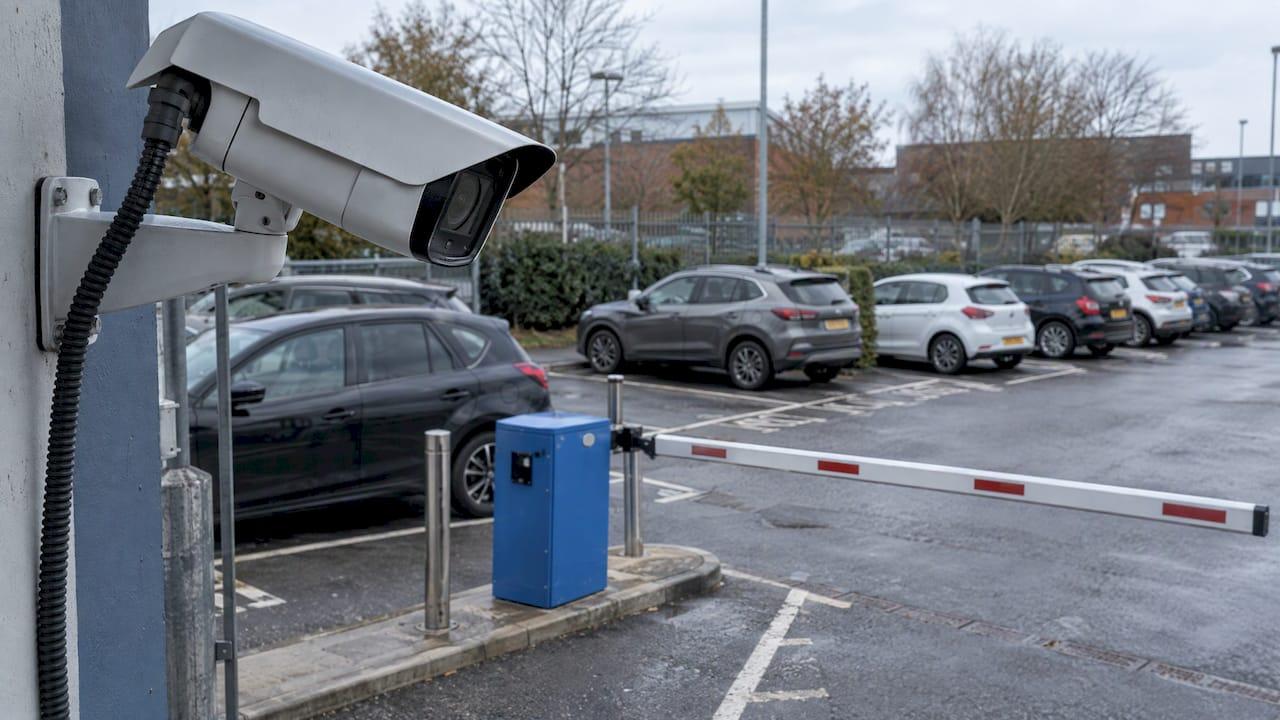
A car park CCTV system earns its place when it is designed around what the footage must show: a face, a registration plate, a vehicle leaving. That means cameras chosen and positioned for each entrance, aisle and blind corner, recording that police can use, and signage and data-protection paperwork in place before the first camera goes up. It is a design job for one accountable engineer, not a box of cameras on poles. This guide covers what you need to know whether you run a school or nursery car park, a church or mosque car park, a business forecourt or a private residents' car park.
TL;DR
- Car parks are where CCTV has shown the strongest results: a College of Policing review found a 37% overall crime reduction in car park studies.
- Coverage quality beats camera count. Plan each entrance, exit, pedestrian route and lift first, then fill in the gaps, and judge the plan at night as well as by day.
- Recordings must be usable by police: readable plates, correct time stamps, a clean export and at least 31 days of storage as a sensible baseline.
- You need a lawful basis, clear signs and a data protection impact assessment before installation.
- One engineer who surveys, specifies, installs and commissions the system keeps accountability in one place.
Table of Contents
- Why car parks respond so well to CCTV
- Start with the risks, not the cameras
- Where to put the cameras
- Make the footage usable by police
- The legal side: lawful basis, signs and assessments
- Who should install it
- What different sites need
- A worked example of a plan
- Where we come in
- Our view
- FAQ
- Sources
Why car parks respond so well to CCTV
Car parks are quiet, repetitive spaces where offenders can pick a vehicle, check for witnesses and leave in minutes. That is exactly the pattern cameras interrupt. The College of Policing's crime reduction toolkit reports that the largest and most consistent CCTV effects were in car parks: across eight studies, crime fell by 37% in treated areas compared with control areas, and five of the eight showed statistically significant reductions.
The same review suggests why. CCTV appears to work by raising an offender's perceived risk of being caught and by helping organisations deploy security staff. It also found that schemes with active monitoring achieved a statistically significant 15% overall crime reduction, while schemes without active monitoring did not. For a site owner, the lesson is practical: a camera nobody can respond to is a recording device, while a camera tied to alerts and a response plan is a deterrent.

That shapes everything below. You are not buying cameras, you are buying a result: fewer incidents, and good evidence when something still happens.
Start with the risks, not the cameras
Before choosing hardware, write down what the system has to achieve. ProtectUK, the police-backed protective security advice service, recommends agreeing an operational requirement first, because lens type, field of view, lighting and weather conditions all follow from it. Typical aims for a car park include:
- Identify people entering and leaving on foot, so a face is recognisable.
- Read the registration plate of every vehicle at entry and exit.
- Observe the aisles and bays to see theft from or damage to vehicles.
- Protect staff, parents or worshippers walking to their cars after dark.
- Record collisions, disputes and vehicle damage, which also helps with insurance claims.
Each aim needs a different camera view. A wide camera that shows the whole car park is good for observing, but it will not identify a face at 40 metres. Trying to meet every aim with one view is the most common reason footage disappoints.
Where to put the cameras
The Youth Endowment Fund reviewed 13 UK CCTV schemes and found that camera density, coverage and positioning varied widely because there was little guidance. It also found that greater density was not necessarily linked to larger crime effects, while incomplete coverage meant people could not be properly followed from one camera to the next. Coverage quality matters more than raw camera count.
In practice, work through the site in this order:
- Vehicle entrances and exits. British Parking's guidance for new car parks says static entry cameras should capture the front of the vehicle with the plate readable when it is stationary at the barrier, with a view of the front-seat occupants, and that date and time overlays must not cover the plate.
- Pedestrian access points and lifts. The same guidance expects all pedestrian and vehicle access points and all lifts to be covered, with cameras capable of identifying the person shown.
- Aisles and bays. Straight rows of spaces aid surveillance and avoid blind spots, and support pillars should be placed for maximum uninterrupted natural surveillance. On an existing site you cannot move pillars, so cameras have to be placed to see around them.
- Pay machines, payment points and help points. These are common points of conflict and theft.
- Boundaries and dark corners. Fence lines, bin stores and lightly used levels need their own view.
Guidance also says cameras should be visible but sensitively positioned, so they deter without harming the look of the building, and housed in vandal-resistant casings where they are within reach.
Check it at night
The Youth Endowment Fund report found that cameras in several schemes performed poorly after dark because positioning decisions had been made only in daylight. A car park changes completely at night: headlights flare, shadows deepen and lighting may be patchy. Specify cameras for the worst lighting on the site, and review the plan with that in mind.
Fixed, pan-tilt-zoom and automatic tours
ProtectUK suggests considering whether pan-tilt-zoom (PTZ) cameras are needed to support fixed cameras. Fixed cameras give you a permanent record of the places that matter, such as the barrier. PTZ cameras let an operator follow an incident across a large site. The research is a warning against leaving PTZ cameras on an automatic rotating tour: operators in the YEF review felt rotating cameras were easy to avoid and could miss the essential moment of an incident. Fixed cameras on the critical points, with a PTZ as a back-up for tracking, is the safer design.
Make the footage usable by police
This is where many installations fail. The GOV.UK police requirements for CCTV, published in August 2022, ask owners to consider quality, storage, export and playback. The practical points:
- Test on recorded video, not the live screen. The guidance advises a subjective test, such as a volunteer walking through the car park or parking a car, under real operating conditions, then viewing the recording.
- Keep the clock right. The system time should be correct for GMT and BST, because a time stamp that is an hour out can undermine evidence.
- Keep at least 31 days. Longer retention may be useful in some circumstances, but it must not degrade more recent recordings.
- Let police get the footage. Proprietary software or hardware access controls should not stop police or the Crown Prosecution Service from obtaining it. A locked equipment room can be as effective as software controls.
The Surveillance Camera Code of Practice adds a second principle: no more images and information should be stored than strictly required for the stated purpose, and they should be deleted once that purpose has been met. So set a defined retention period, write it down, and make sure someone is responsible for retrieving and passing on footage when police ask. Keeping a simple log of camera checks and retention reviews helps here, and a guide to safety file contents for small sites shows how to set proportionate retention periods and keep records you can find quickly.
The legal side: lawful basis, signs and assessments
Car park CCTV captures personal data, so UK data protection law applies. You do not need to be a lawyer, but you do need to cover four things.
A documented lawful basis. The Information Commissioner's Office (ICO), the UK's data protection regulator, says any use of CCTV needs a lawful basis under Article 6 of UK GDPR. For most private operators that is legitimate interests, supported by a Legitimate Interests Assessment, which records why you need the cameras and why that does not override people's rights.
Signage. For a public multi-storey car park, the ICO says signs must be readable within the car park and before people enter it. They should name the operator, state the purpose and give a contact for queries.
An impact assessment. A data protection impact assessment should be carried out before a surveillance system is installed, and again when new technology is added or images are captured from a new location. A council template updated in January 2026 sets out those triggers, drawing on the surveillance camera code.
Controlled viewing. Only people with an operational need should view images, in a controlled environment. If you are unsure which basis applies to your site, ask your data protection officer or the ICO before installation. Your installer should design the system so that these questions are easy to answer.
Who should install it
ProtectUK advises checking that a CCTV installer is registered with a UKAS-accredited inspectorate, so they work to British and European standards and an approved code of practice. It also says a reputable contractor will provide a technical specification and carry out an audit and commissioning test that proves the system meets the operational requirement.
That is a useful checklist for any quote. Ask who will survey the site, who will specify the cameras, who will install them and who will sign off the commissioning test. When those are four different people, or when installation is passed to a subcontractor, nobody owns the result. Ask also what happens after handover: servicing, a fault at 2am, a request from police for footage.
What different sites need
| Site | Main priority | Typical design focus |
|---|---|---|
| School or nursery | Safe drop-off, staff walking out late | Gate and pedestrian identification, clear night views, link to access control at entrances |
| Place of worship | Evening events, vehicle theft, vandalism | Well-lit coverage of approach routes, boundary views, remote viewing for trustees |
| Business or industrial unit | Theft of vehicles, loads and fuel; out-of-hours intrusion | Plate capture at the gate, perimeter cameras, link to an intruder alarm |
| Residential block or private drive | Vehicle crime, unauthorised parking | Entrance cameras, door entry and a few well-placed aisle views |
| Construction compound | Plant and material theft | Temporary, relocatable cameras with remote alerts |
A private home with a driveway has a different scale of need; our home security service covers cameras and alarms for that.
A worked example of a plan
Imagine a church hall car park with 40 spaces, one entrance and a side path to the hall door. The brief is to deter vehicle theft during evening events and to see who is on the path at night.
A sensible design would put a fixed camera on the entrance aimed to read plates at low speed, a second on the hall door to identify faces, and one or two wide-view cameras covering the bays and the boundary fence. Lighting is checked at night so the plate camera is not blinded by headlights. Footage is recorded to a unit in a locked room, retained for a set period, clock set to UK time, and a sign at the entrance names the operator and a contact. A volunteer then walks the path and parks a car, and the team reviews the recording. That final check, from the police guidance, is what turns a plan into evidence.
Four cameras covering the right views will outperform twelve covering the same wide area.
Where we come in
We design, install and SSAIB-certify CCTV and remote monitoring for schools, places of worship, businesses and homes across Liverpool and the North West. Every system is specified, installed and certified by the same experienced engineer, with no salespeople and no subcontractors, so the person who walked your car park is the person who commissions the system. Quotations are fixed, installation is tidy, and remote monitoring and app control are available so you can check the site from your phone.
For sites that need a response, we also offer police-response monitored systems, annual servicing and a 24-hour callout through our service and maintenance offer. If you want a car park survey and a fixed quotation, start with our CCTV page or contact us through the main site.

We work from Merseyside to Cheshire and Lancashire, including Liverpool, Warrington and Wigan.
Our view
Most car park CCTV problems we hear about start before a single camera is fitted. Someone decides on a number of cameras, a price is agreed, and nobody has asked what the footage must show.
We would reverse that. Walk the site, ideally at dusk, and decide what each camera is for: plates at the gate, faces on the path, an overview of the bays. Then choose the equipment. The research backs this: coverage quality matters more than the number of cameras, and monitored systems perform better than unwatched ones.
That is why we do not split the job between a salesperson, an installer and a subcontractor. One engineer specifies the system, installs it and certifies it, so the person who understood your risks is the person who tests the result. You get a fixed quotation, a tidy installation and someone to call, day or night, if something goes wrong.
If your car park serves children, worshippers or staff who leave after dark, we would link the cameras to access control and, where it is justified, a monitored alarm, so a recording becomes a response.
Freddie
FAQ
Does car park CCTV really reduce crime?
The College of Policing found the strongest CCTV results in car parks, with a 37% overall fall in crime across eight studies. Actively monitored schemes did better than unmonitored ones overall. Results depend on good design and on someone acting on what the cameras see.
How long should I keep car park CCTV footage?
There is no single legal figure, but police guidance treats 31 days as a sensible baseline and says longer retention must not degrade recent recordings. The surveillance camera code says to store no more than you need for your stated purpose. Choose a period, document it and delete footage once it is no longer needed.
Do I need signs for car park CCTV?
Yes. The ICO says signs must be readable before people enter and inside a public car park, and should name the operator, the purpose and a contact for queries. Place them at every entrance and at regular points inside.
Can I record sound in a car park?
Audio is more intrusive than video and is harder to justify. Ask for video-only recording unless you have a specific, documented reason, and discuss it with your data protection officer or the ICO before it is switched on.
Who can install CCTV in a car park?
Choose an installer registered with a UKAS-accredited inspectorate, working to British and European standards, who provides a technical specification and a commissioning test. We are SSAIB-certified, and the engineer who surveys your site is the one who installs it.
Sources
- Closed-circuit television (CCTV), College of Policing
- CCTV, ProtectUK
- Toolkit technical report, Youth Endowment Fund
- New Build Car Park Guidelines, British Parking
- Police requirements for CCTV systems, GOV.UK
- Amended Surveillance Camera Code of Practice, GOV.UK
- Surveillance systems and the data protection principles, ICO
- Data Protection Impact Assessment, Corsham Council