
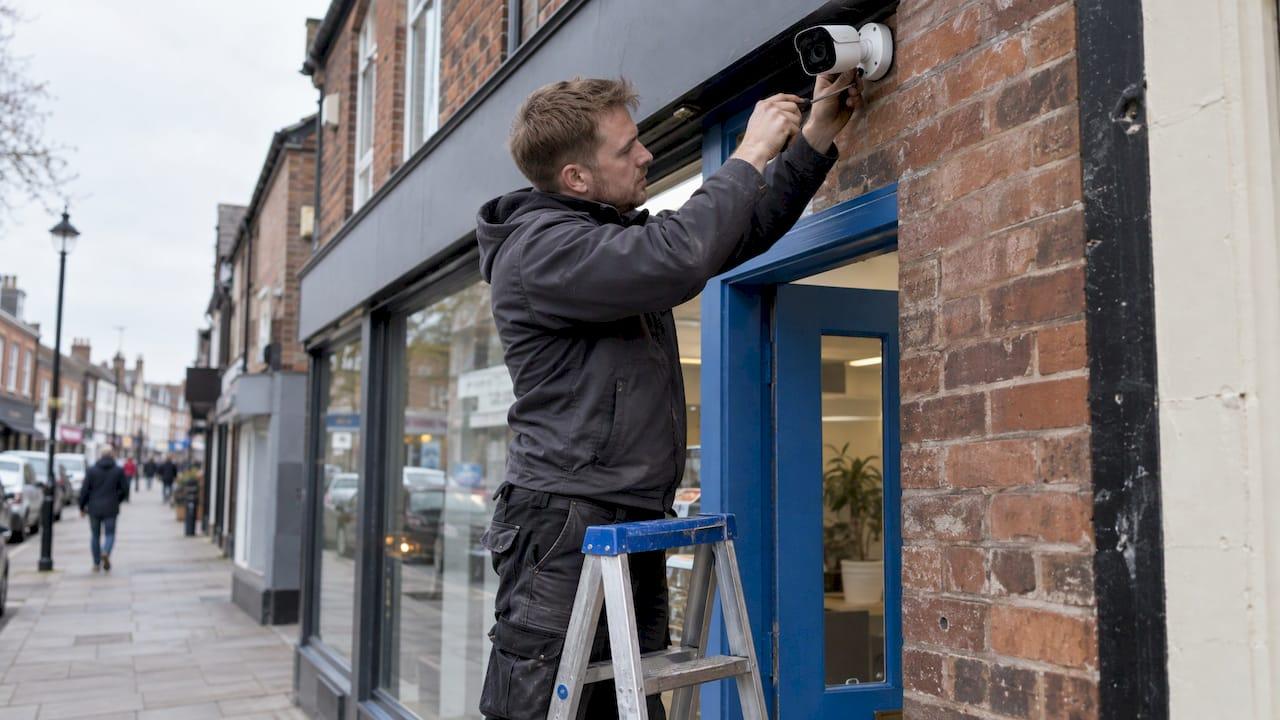
The best CCTV installation in Wigan starts with a site survey and ends with a fixed quotation. The same accredited engineer designs it, fits it and signs it off. That order matters more than the cameras. A system planned around your entrances, your lighting and your own risks will give usable footage. One bought off a shelf and fixed to the wall often won’t.
We install for homes, schools and nurseries, places of worship and businesses across Wigan and the North West. This guide covers what a good installation includes, what it costs, the rules you need to follow and the checks that separate a reliable installer from a risky one.
TL;DR
-
A proper installation begins with a site visit and a written design, not a catalogue of cameras. Ask for a fixed quotation after the survey.
-
Every site is different, so the cost depends on the number of cameras, cable runs and recording setup. We survey first and give a fixed written quote before any work starts.
-
Choose an installer certified by a UKAS-accredited body such as SSAIB or NSI, and get at least three proposals, as the Home Office advises.
-
If your cameras record beyond your boundary, or you run a business, data protection rules apply: signage, secure storage and regular deletion.
-
Plan the aftercare at the start: servicing, fault response and who checks that the recorder is actually recording.
Table of Contents
What a proper CCTV installation involves
Most disappointing CCTV has the same cause: nobody decided what the system was for. A camera that shows a car roof but not the number plate, or a doorway washed out by evening sun, is a design failure, not a hardware failure.
A sound installation follows a sequence.
-
Define the purpose. Deterring theft, identifying a person at the door, monitoring a car park, protecting a school entrance and keeping an eye on stock are different jobs. NSI, the security industry certification body, says it is essential to be clear what you want the system to provide and when it needs to operate, so the design and quotation are accurate.
-
Survey the site. The installer walks the property with you and looks at entrances, exits, blind corners, lighting, cable routes and where the recorder can sit safely. NSI-approved companies are assessed to carry out a risk assessment and site survey before a design is developed.
-
Agree the design in writing. This lists camera positions, camera types, how long footage is kept, how it is retrieved and how you will view it remotely.
-
Install and tidy. Cabling is neat, protected from weather and tampering, and the cameras are fixed so the view can’t be easily knocked out of place.
-
Commission and hand over. You are shown how to view live and recorded footage, how to export clips and who to call if something stops working.
-
Plan the aftercare. Servicing and fault response should be agreed before you sign.
We work this way. Every system is specified, installed and SSAIB-certified by the same experienced engineer, so the person who walked your site is the person who fits the cameras. We also give clear fixed quotations after the survey.
What CCTV installation costs in Wigan

Nobody can honestly quote a price for a CCTV system without seeing the property. The price follows the factors NSI lists: how many cameras and of what type, the image detail needed, the recorder’s capability, the amount of storage and the quality of equipment. Extras such as lighting, detection, video analytics, remote monitoring or backup power add to it.
Every site is different, so the cost depends on the number of cameras, cable runs and recording setup. We survey first and give a fixed written quote before any work starts.
Why a fixed quotation matters
A vague estimate that grows once the work starts is the usual cost complaint. After a survey, a fixed quotation names the cameras, the recorder, the cabling, the commissioning and the handover. Compare quotations line by line, not just by total. Two quotes at the same price can hide very different cameras and storage.
A backup power supply is worth including. A UPS keeps the recorder running through a power dip and shuts it down cleanly, which protects the footage. Published guidance recommends one for any recorder.
How to choose a CCTV installer in Wigan
The Home Office’s Surveillance Camera Commissioner’s Buyers Toolkit is the most useful single document for a buyer. It advises getting proposals from at least three providers and checking their credentials. It also says companies registered with UKAS-accredited certification bodies such as NSI or SSAIB are more likely to give a consistent approach because they are audited regularly.
UKAS is the national body that accredits the certifiers. In practice, the checks are these.
-
Certification, and its scope. Ask for the certificate and check it covers the work you want. Certification for one type of security work does not automatically cover another.
-
Standards. The toolkit says systems should be installed to BS EN 62676, the standard for video surveillance systems. Remotely monitored, detector-activated CCTV is covered by BS 8418.
-
A written survey and design before any price is fixed.
-
Who does the work. If the person who surveys is not the person who installs, or the job is passed to a subcontractor, ask who is accountable for the finished system.
-
Fault response. NSI says approved companies operate service level arrangements and typically respond to a fault within 24 hours.
-
Local references. Ask for examples of comparable installations: a school, a church, a shop, a house like yours.
We hold SSAIB certification, and you can see our accreditations on the site. Because one engineer specifies, installs and certifies each system, there is one person to hold to account if anything needs putting right.
Local installers versus national firms
A local engineer is quicker to attend and knows the area. For a school on the edge of town, a church hall or a shop in a busy centre, ask how fast someone can be on site. We cover Wigan, Warrington, Liverpool and the wider North West.
Planning camera positions, recording and remote viewing
Here is where a survey earns its fee. Good coverage comes from a few decisions.
Position. Cameras should sit where nothing obstructs the view and, wherever possible, not look straight into bright light. They need to be high enough and fixed firmly enough that an intruder can’t easily turn them away, yet reachable so they can be serviced safely. Priorities on most sites are entrances and exits, side gates, car parks, delivery areas and any place valuables or stock are kept.
Image quality for the job. There is a difference between seeing that someone is there, recognising who they are and reading a number plate. Ask the installer to show what each camera will actually see at the times that matter, including after dark.
Recording. Decide how long footage is kept and who can retrieve it. A bigger hard drive means longer retention. If you run a licensed premises, Wigan Council’s model licensing conditions expect an effective system in good working order, recordings kept for at least 28 days, and breakdowns reported within 24 hours. Check your own licence conditions with the Wigan Council licensing guidance, because the police may agree camera types and positions with you.
Remote viewing. Phone and app access is convenient, and it must also be secure. Our systems include remote monitoring and app control options, so you can check cameras from anywhere. Strong passwords and a properly configured network protect the footage from anyone else.
Cabling and weather. Wired PoE cameras are the standard for modern IP installations. External runs need weather-rated cable, and buried runs need armoured cable. Where cabling is impractical, such as a remote yard or agricultural site, a wireless design can work; see how we handled a haulage and agricultural wireless CCTV job.
The rules: privacy, signs and storing footage
CCTV that records people is covered by data protection law once it captures anything beyond your own property, and for businesses in most cases. The Information Commissioner’s Office (ICO) sets out what to do for home CCTV systems:
-
Decide what area, images or audio you really need to capture.
-
Display clear signage.
-
Store footage securely and limit access to people who need it.
-
Delete footage regularly or automatically.
-
Respond properly to requests for footage.
The ICO also advises pointing cameras away from a neighbour’s property, public areas and shared space where possible, and using filters or privacy blockers to blur or mask parts of the image. A good installer builds these masks into the design, so the problem never arises.
The Buyers Toolkit adds that the system must be registered with the ICO and have adequate signage where that applies to you. Businesses, schools, nurseries and places of worship that record people are normally in that position, so settle it before the cameras go live. For retention, Wigan Council’s own CCTV code keeps images for 31 days and then overwrites them unless an access request has been made. Your own period should reflect your purpose and be applied consistently.
CCTV for different properties
Homes
A typical house needs the front door, the driveway or side access, and the back garden covered. Add a video doorbell and you can see visitors without opening the door. Many homeowners pair cameras with intruder alarms so a camera records the event and an alarm raises it. Our home security service covers burglar alarms, home CCTV, smart doorbells and intercoms, and smart home integration, and it can be designed around your daily routine.
Schools and nurseries
Here the priorities are controlling who gets in, seeing who is at the gate and having a plan if something goes wrong. Cameras work best alongside access control and intercoms at the entrance. We also design lockdown systems for schools and event centres; see our education and childcare page.
Places of worship
Buildings that stand empty for much of the week, with valuable fittings and often a lot of visitors at other times, need a design that suits both. Cameras on entrances and the car park, with remote viewing for the people who look after the building, is a common starting point. A survey will find what is specific to your building.
Businesses, construction sites and warehouses
Shops, offices, yards and units need coverage of entrances, loading areas and stock. Our construction sector page covers temporary and site security. Police-response monitored systems are available for businesses that want an alarm signal acted on, and CCTV can be monitored remotely.
Looking after the system after installation
Cameras get dirty, vegetation grows into the view and recorders develop faults. Planning guidance for video surveillance says effective and regular maintenance is essential, and that a maintenance agreement should cover planned preventive visits, corrective visits when something fails and basic user checks.
The user’s own part is simple: look at the live view of each camera weekly, and check that you can play back yesterday’s footage. If a camera is blank or the recorder shows an error, report it the same day.
We offer annual servicing, SSAIB-certified maintenance and system takeovers, if you already have cameras fitted by someone else. Details are on our service and maintenance page.
What we think about CCTV in Wigan
The first question we ask is never “how many cameras?” It is “what do you need to be able to prove, and where?” Answer that and the rest of the design follows.
We have spent over 20 years designing security systems, and the pattern is consistent: the installations that serve people best are the ones where one engineer carried the job from the survey to the sign-off. That person knows why each camera is where it is, and you know exactly who to call.
The engineer who visits you specifies the system, installs it and certifies it to SSAIB standards, and gives you a fixed quotation you can read line by line. Tidy cabling, a proper handover and aftercare are part of the job, not extras.
If you are in Wigan and comparing proposals, ask each installer who will actually be on your roof or up your ladder. The answer tells you a lot.
Freddie
Get a CCTV survey and fixed quotation in Wigan
We design, install and certify CCTV for homes, schools and nurseries, places of worship and commercial premises in Wigan and across the North West. Every job starts with a site survey and ends with a fixed quotation, and the same engineer sees it through. Remote monitoring and app control are available, and so is ongoing servicing.

See our Wigan security page or go straight to the CCTV and remote monitoring service to arrange a survey.
FAQ
How much does CCTV installation cost in Wigan?
It depends on the number of cameras, image quality, storage, cabling and extras, so a survey is the only way to get a true figure. We survey first and give a fixed written quote before any work starts.
Do I need planning permission or to register my CCTV?
For a home, the ICO says data protection law applies if your cameras record beyond your property boundary. You should then use signage, secure storage and regular deletion. Businesses, schools and places of worship that record people need to meet these duties, and the Home Office toolkit says systems should be registered with the ICO.
How long should CCTV footage be kept?
There is no single period for everyone. Wigan Council’s own system keeps images for 31 days, and its model conditions for licensed premises expect recordings kept for at least 28 days. Choose a period that fits your purpose and apply it consistently.
What should I look for in a CCTV installer?
Certification from a UKAS-accredited body such as SSAIB or NSI, installation to BS EN 62676, a written survey and design before pricing, and a clear fault-response arrangement. The Home Office advises getting at least three proposals.
Can I view my CCTV from my phone?
Yes. Modern IP systems support remote viewing through an app. Our installations include remote monitoring and app control options, set up securely at handover.
Sources
-
Surveillance Camera Commissioner’s Buyers Toolkit, Home Office
-
Model Conditions relating to the Licensing Act 2003, Wigan Council