
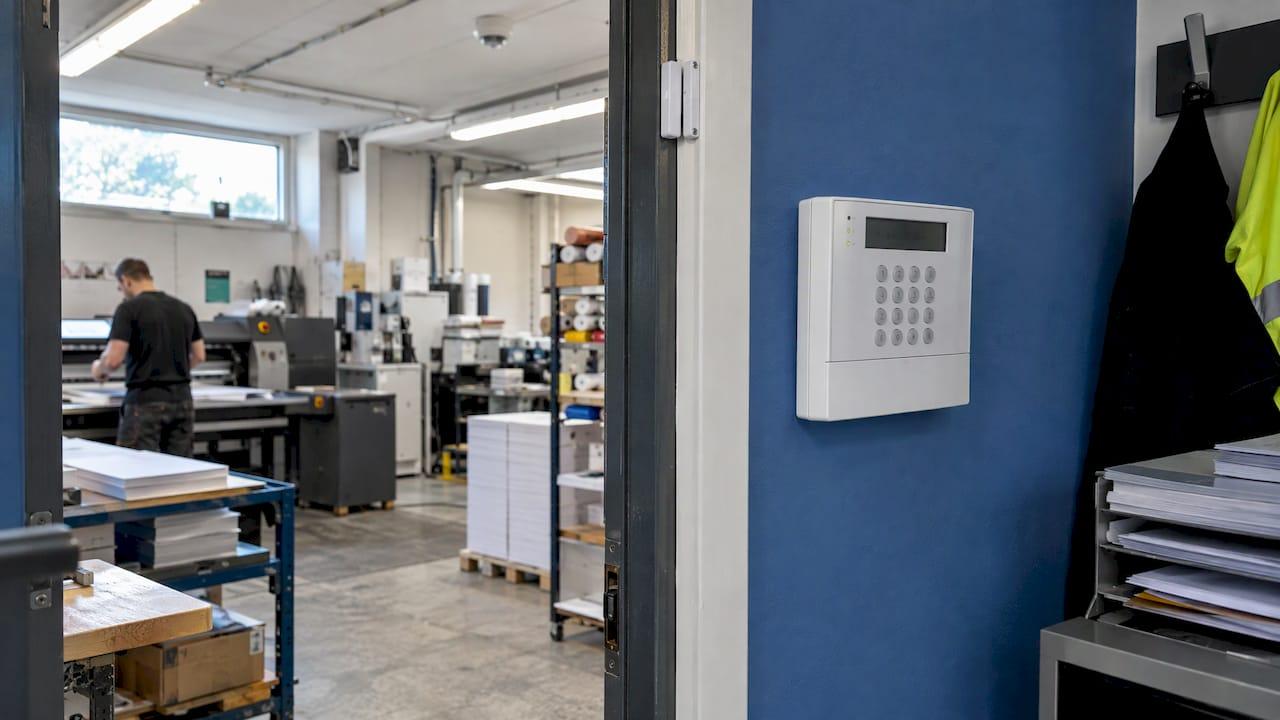
A commercial alarm system is an intruder alarm specified to a graded standard, usually Grade 3, installed by an accredited company and, for most businesses, monitored so that a signal reaches a 24-hour centre rather than just a bell on the wall. Get the grade, the monitoring level and the installer right and you protect the premises, keep your insurer happy and keep police response available. Get any of the three wrong and you can end up with a system that looks fine but does not meet your policy conditions.
We design, install and SSAIB-certify commercial alarms across Liverpool and the North West, and the engineer who surveys your building is the one who fits the system. This guide sets out what you need to know before you ask for a quote.
TL;DR
- Most commercial premises are insured against a Grade 3 system under PD 6662. Lower-risk sites may be accepted at Grade 2, but check your policy first.
- The main choices are audible only, speech dialler, monitored with keyholder response, or monitored with police response. Police response needs an approved installer and an approved monitoring centre.
- Your insurance policy will probably require a maintenance contract, suitable keyholders and notice of any change to the system.
- A Grade 3 system needs two site visits a year, or one visit and one remote check, under BS 9263.
- Start with a site survey and a fixed quotation, so the design matches your risk rather than a standard package.
Table of Contents
- What makes an alarm "commercial"
- UK grades and what they mean for your premises
- The four types of business alarm
- What is inside the system
- How monitoring and police response work
- Choosing a system: a practical process
- Maintenance and insurer conditions
- Alarms for different types of business
- What we offer
- Our view: specify it once, and specify it properly
- FAQ
- Sources
What makes an alarm "commercial"
The hardware overlaps with a home system: a control panel, detectors on doors and in rooms, a keypad, sounders and a way of sending a signal out. What changes is the standard it has to meet, the value of what it protects and who is entitled to ask for evidence that it was done properly.
In the UK, intruder alarms are designed to the BS EN 50131 series, applied through the national document PD 6662. That scheme grades systems from 1 to 4, and grading rests on the likely skill, tools and determination of the intruder. Grade 1 is the lowest and Grade 4 the highest, and the grade of the whole system is set by its lowest-graded component. That last point matters when someone suggests cheaper detectors to save money: one lower-grade part brings the whole system down.

Insurers draw the commercial and domestic line by grade. Aviva's loss prevention guidance describes Grade 2 as typical for most homes and some lower-risk commercial premises, such as those without public access. For most commercial premises the usual expectation is higher, as the next section explains.
There is also a practical difference. A shop, office, school or workshop usually has several users, shifts, deliveries, cleaners and keyholders. A commercial system therefore needs sensible user codes, zoning that suits how the building is used, and an out-of-hours response plan. A home alarm rarely needs any of that.
UK grades and what they mean for your premises
BIBA's guidance for purchasers explains that PD 6662 requires grades 1 to 4, with Grade 4 the highest, and that Grades 2 and 3 are the ones most often asked for. Insurers typically regard Grade 2 as suitable for lower-risk commercial premises and Grade 3 for most commercial premises.
| Grade | Intruder profile | Typical use |
|---|---|---|
| 1 | Low risk, little knowledge or equipment | Rarely specified for business |
| 2 | Low to medium risk, some knowledge and basic tools | Homes, some lower-risk commercial sites |
| 3 | Medium to high risk, good knowledge and a range of tools | Most commercial premises |
| 4 | High risk, planned and equipped | High-value or high-security sites |
The grade descriptions follow the PD 6662 approach summarised by the insurer guidance above. The safest default, according to Protector's risk management guidance, is Grade 3, which it calls the grade of choice for commercial premises. If you are not sure what your insurer demands, Grade 3 is the grade to ask for.
Why your insurer has the final say
The grade you actually need is written into your policy or the insurer's alarm conditions. Read them before the survey, and give the engineer the wording. A design that exceeds the minimum costs a little more at the start. A design that falls short can leave you with an alarm that does not satisfy the policy.
The four types of business alarm
Aviva describes four common configurations, and NSI groups them into two broad families: audible-only alarms and remotely monitored alarms.
- Audible only. A bell or sounder on the outside of the building. It relies on someone nearby hearing it and doing something. Unmonitored local-audible systems fit Grade 2E under the BIBA guidance.
- Speech or voice dialler. The system calls out to nominated numbers when it activates.
- Monitored, keyholder response. The signal goes to a 24-hour alarm receiving centre (ARC), which contacts your nominated keyholders.
- Monitored, police response. Where the activation qualifies, the ARC can request police attendance. NSI says this needs an approved installer and an approved ARC.
For a business holding stock, equipment, cash or data, option 3 or 4 is the realistic choice. A bell alone does nothing at 3am if nobody is within earshot. Our police-response monitored systems are SSAIB-certified, which is the accreditation route insurers look for.
What is inside the system
NIST's guide to commercial intrusion alarms, an older US document but still a clear statement of the basics, says every intrusion system has three elements: a sensor to detect an intruder, a control unit to process and transmit the signal, and an alarm device to summon help. It adds that some means of carrying information between those parts is needed.
In a modern commercial installation that translates into:
- Detectors: door contacts, passive infrared motion sensors, glass-break detectors and, where needed, beam or perimeter detection outside.
- Control panel: the brain of the system, holding the zones, user codes and event log.
- Keypads and fobs: how staff set and unset the system.
- Sounders and strobes: the audible and visual warning.
- Signalling: the path to the monitoring centre. Resilient signalling matters because a monitored alarm is only as good as its connection.
- Hold-up or panic devices: protection for staff at the counter or in the stockroom.
NIST also notes that protection can be spot (a safe or a specific object), perimeter, area or volume, and hold-up, and that these can be combined to match the threat. A jeweller, a warehouse and a nursery each combine them differently, which is why a standard package seldom fits.
Adding CCTV and access control
An alarm tells you something has happened. CCTV and remote monitoring shows you what, which helps you decide whether to attend and gives you evidence afterwards. Access control keeps the wrong people out in the first place and records who came in. Designing the three together means one set of user records and one point of contact if something fails.
How monitoring and police response work
NSI explains that a remotely monitored alarm sends its signals to a 24/7 monitoring centre. That centre can notify the police after a confirmed alarm signal, call your nominated keyholders, or alert a linked keyholding service.
Three points decide whether you actually get police response:
- The installer and the ARC must be approved. Aviva states that NSI or SSAIB accreditation is a pre-requisite for police-response alarms.
- The system must meet the current standards. NSI says that, to obtain police response, systems installed since June 2019 must conform to PD 6662:2017 and BS 8243.
- You need a URN. BIBA says insurers typically expect a monitored system to have a unique reference number.
The last point carries a warning. BIBA notes that too many false alarms can lead to police response being curtailed or withdrawn, which in turn can affect your insurance cover. Good detector choice, correct placement and proper staff training are the best defence. A system that is designed for the building and used correctly by the people in it rarely generates the false calls that cost businesses their response.
Choosing a system: a practical process
Aviva advises that the alarm type should come from a formal risk assessment by an appropriately accredited alarm company, taking the insurer's recommendations into account. Here is how that works in practice, and where each step tends to go wrong.
1. Read your insurance conditions
Find the alarm clause in your policy or schedule. Note the required grade, whether monitoring or police response is expected, who must install and maintain the system, and what you must tell the insurer. If the wording is unclear, ask your broker to confirm it in writing. The mistake here is assuming that the system the last occupant had is still compliant.
2. Assess what you are protecting
List the high-value items, where they are kept, when the building is empty and how a thief would approach it. The risk assessment links the alarm configuration to the value of the assets and the safety threats to people. Low-value stock in a staffed unit points one way. A stockroom of electronics behind a rear yard points another.
3. Choose an accredited installer
Aviva's guidance says a competent installer should be accredited by an independent certification body, and names NSI or SSAIB approval as the best indicator of competence. Our accreditation details are on our accreditations page.
The step goes wrong when the person who sells the system is not the person who fits it. At Impact Security Systems the same engineer specifies, installs and certifies each system, with no salespeople or subcontractors, so the person who made the design decisions is the person accountable for them.
4. Get a site survey and a fixed quotation
A quotation produced without visiting the building is a guess. A survey lets the engineer check construction, entry points, cable routes, signalling options and how your staff actually work. We start every job with a site survey and give a clear fixed quotation afterwards, so you know the cost before work begins.
5. Commission, test and record
BS 9263 says the installed system should be inspected and functionally tested against the design proposal and installation plan, with results recorded on a checklist. Ask for that paperwork. It is your evidence if the insurer asks.
6. Set up users and keyholders
Give each user their own code, remove leavers promptly and name keyholders who can reach the site quickly. BIBA lists suitable keyholders and prompt attendance after an activation or fault among typical insurer conditions.
Maintenance and insurer conditions
A commercial alarm is not a fit-and-forget item. BS 9263 sets preventative maintenance by grade: for a Grade 3 system under BS EN 50131 (PD 6662), two site visits a year, or one site visit plus one remote system check. Maintenance records should be kept for at least 15 months.
BIBA lists typical conditions that insurers attach to alarms:
- installation, maintenance and monitoring by a listed company
- a current maintenance contract
- telling the insurer about system changes
- setting the alarm whenever the premises are unattended
- suitable keyholders who attend promptly after an activation or fault
- telling the insurer if police response is reduced or withdrawn
Our annual servicing and SSAIB-certified maintenance is offered as an optional contract, and we also provide a 24-hour callout and system takeovers if you have inherited an installation you want looked after.
Alarms for different types of business
The right design depends heavily on how the building is used.
- Offices: Door and motion detection, hold-up devices at reception and integration with access control. Our office alarm case study shows how a compact system can be zoned.
- Shops and leisure venues: Public access during the day means careful zoning so that the system can protect back-of-house areas. See our leisure and public sector work.
- Construction and yards: Perimeter protection, CCTV and sometimes wireless solutions for sites without cabling. We cover this on our construction page.
- Schools and nurseries: Intruder protection alongside lockdown systems and door entry.
- Haulage and agricultural sites: Large open areas where wireless CCTV supports the alarm, as in this haulage and agricultural example.
Small businesses often ask whether a cheap boxed kit will do. Under an insurance condition that requires an accredited installer or police response, it usually will not, because that route runs through an approved company and monitoring centre.
What we offer
We design, install and SSAIB-certify commercial intruder alarms for businesses, schools, nurseries and places of worship in Liverpool and across the North West, including Warrington and Wigan. Systems are tailored to the building, include remote monitoring and app control options, and are fitted by a qualified engineer rather than a subcontractor. We have more than 20 years in the field and a 5.0 rating from 44 Google reviews.
If you want a system specified for your premises and insurer, book a survey for a commercial intruder alarm and you will receive a fixed quotation.

We cover Liverpool, Warrington and Wigan, and the wider North West. If you also need protection at home, our home security page covers burglar alarms and home CCTV.
Our view: specify it once, and specify it properly
Most of the trouble we see with business alarms starts before the first detector goes up: a design drawn from a price list rather than from the building. We believe the person who surveys your premises should be the person who designs, fits and certifies the system. That is how we work, and it keeps one engineer accountable from the first visit to the handover.
For a commercial site, we would start from the insurer's conditions and the real risk, then choose the grade, the detection and the monitoring level to match. Add remote monitoring and app control so that you can see what your system is doing without being on site, and keep it serviced so that it stays within your policy.
A fixed quotation, tidy installation and proper aftercare matter as much as the equipment. The alarm only earns its keep on the night it is needed, and that night is when the quality of the original design shows.
Freddie
FAQ
What grade of alarm does a commercial property need?
Most insurers expect Grade 3 for commercial premises, and some lower-risk sites are accepted at Grade 2, according to BIBA. Your policy wording is the deciding factor, so check it before the survey. If you are unsure, Grade 3 is the usual safe choice.
Can a business alarm call the police?
Yes, where the system is monitored and qualifies for police response. That requires an approved installer, an approved monitoring centre and a system that meets PD 6662:2017 and BS 8243 if installed since June 2019. You also need a unique reference number from the process the installer manages.
How often does a commercial alarm need servicing?
For a Grade 3 system, BS 9263 specifies two site visits a year, or one visit and one remote check. Many insurers also require a current maintenance contract, so keep the service records.
What happens if my alarm keeps false alarming?
BIBA warns that repeated false alarms can lead to police response being reduced or withdrawn, which may affect your insurance. Correct detector selection, placement and staff training reduce the risk. Tell your insurer if police response changes.
Is a small business alarm different from a large one?
The standards are the same, but the design is smaller. A small shop may need only a handful of detectors and a hold-up button, while a larger site needs more zones and more users. The grade still follows your insurer's requirements and risk.
Sources
- Intruder Alarms: Guidance for purchasers, BIBA
- Intruder alarm systems for business and commercial premises, NSI
- Intruder and Hold Up Alarms, Aviva
- Intruder alarms and European standards, Aviva
- Intrusion and Hold-up Alarm Systems, Protector RM guidance
- BS 9263:2016 Intruder and hold-up alarm systems
- Selection and application guide to commercial intrusion alarms, NIST