
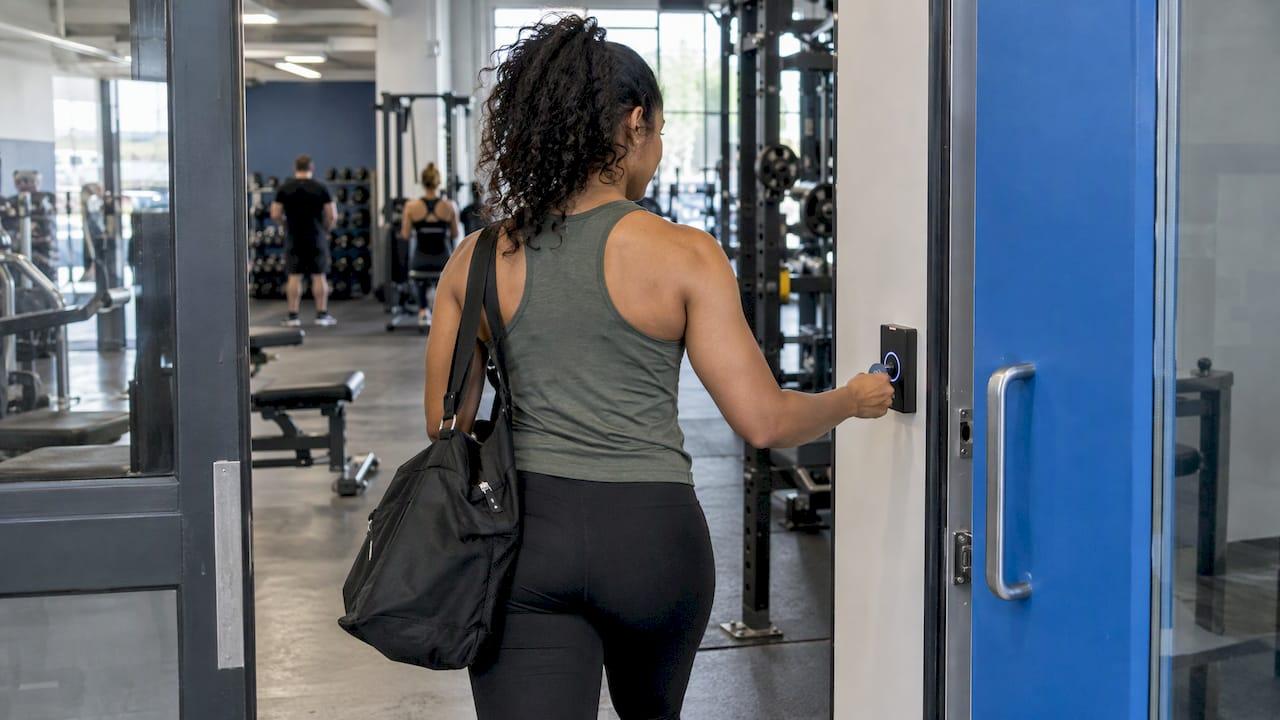
Gym access control is a system of locks, readers and software that decides who can enter your building, when and through which door, without a member of staff standing at reception. A good one links to your membership list, lets paying members in at any hour, shuts out anyone whose membership has lapsed, and releases every door safely in a fire. The difference between a system that quietly works and one that causes complaints is made at the design stage: where the doors are, which credential suits your members, and how the lock behaves when the power fails. We design, install and SSAIB-certify access control in Liverpool and the North West, with the same engineer specifying and fitting the system.
TL;DR
- Every gym system has three parts: a lock, a reader and the software that decides who gets in. The software link to your membership records matters as much as the hardware.
- App-based QR codes backed up by a PIN, card or fob suit most gyms. Turnstiles are the only option that physically admits one person at a time.
- Doors on escape routes must release on fire alarm and power failure. Plan this before you choose locks.
- If you add CCTV or facial recognition, UK data-protection rules apply, and consent cannot be the price of entry.
- Costs depend on door count, door type and whether you want turnstiles, so a site survey and fixed quote is the only reliable figure.
Table of Contents
- What gym access control actually does
- Choosing how members get in
- Making 24/7 entry safe: tailgating and unstaffed hours
- Fire safety: the part you cannot leave until last
- Data protection: what you must get right
- Questions to settle before anyone quotes
- What does gym access control cost?
- Who needs what: a quick guide by premises
- Our view: design the doors, not just the reader
- Talk to us about your gym
- FAQ
- Sources
What gym access control actually does
Take a typical gym with a front door, a studio, a changing area and a staff office. Without access control, someone has to unlock in the morning, check cards at the desk and lock up at night. With it, each door has a reader. A member presents a credential, the system checks the membership record, and the lock releases if the person is allowed in at that time.
Three parts make this work:
- The lock. An electric strike, a magnetic lock or a motorised barrier such as a turnstile.
- The reader. A device that reads a card, fob, QR code, PIN or, in some systems, a face or fingerprint.
- The controller and software. The brain that holds the rules: who, when, which door. In a gym it is usually fed by your membership system, so a cancelled direct debit stops working the same day or soon after.
That last link is where most disappointment arises. Some membership platforms push changes to the door hardware straight away, others on a cycle of a few minutes, and some need a dedicated PC on a stable wired connection to do it. Ask which applies before you buy anything, because it decides whether a member who has just joined can get in at 6am, and whether one who has just cancelled is locked out promptly.
Choosing how members get in
The credential is what your members will touch every day, so it is worth choosing deliberately. The main options differ in convenience, how easily they are shared, and the privacy questions they raise.
| Method | Convenience | Weak point | Best for |
|---|---|---|---|
| QR code on a phone app | Very high; nothing extra to carry | Needs a charged phone and a signal for the app | Most members of a 24/7 gym |
| PIN code | Easy, no hardware for the member | Easily shared or watched over a shoulder | Back-up, or staff doors |
| Card or fob | Quick, familiar | Can be lent to a friend, lost or cloned | Members without smartphones |
| Biometric (face, fingerprint) | Hands-free | Privacy and consent obligations | Only where you can offer a fair alternative |
Gym-technology publishers describe QR, PIN, card and biometric options in much the same way, and note that PINs and cards can be shared while biometrics reduce sharing but bring consent questions. The same material points to a hybrid, a phone QR code supported by a PIN or fob, as the most practical arrangement for operators. That matches what we would recommend for most sites: one main method that members use without thinking, and one fallback so nobody is stuck outside with a flat battery.
Turnstiles and when they earn their place
A door reader tells you who opened the door, not how many people walked through it. A turnstile is the only option that physically restricts access to one person at a time. For a busy city-centre club with hundreds of visits a day and a staffed desk, that can be worth the space and cost. For a smaller unstaffed gym, a well-chosen door system plus cameras usually covers the need. The right answer depends on your floor plan, your footfall and the width of your entrance, which is why it is settled on site.

Making 24/7 entry safe: tailgating and unstaffed hours
Tailgating means one person badging in and a second slipping through behind them. Unstaffed gyms are exposed to it, and every tailgater is a non-paying user in your building, with the insurance and safety questions that follow.
No single device removes the risk. A layered approach works better:
- A vestibule or lobby with two doors, so the second only opens once the first has closed.
- A turnstile or speed gate at the main entrance where the space allows.
- Door-held-open alarms that sound locally and alert a manager when a door stays open too long.
- CCTV covering the entrance and the reader, so you can match entries to faces after the event and deter casual abuse. Remote viewing means a manager can check an alert from a phone rather than driving in at night.
- Clear membership terms that make it a breach to let anyone in.
A gym that is empty overnight also has a break-in risk once the last member leaves. A monitored intruder alarm on the office, reception till area and equipment store, set up to work alongside the access control, means the building is protected when the final member walks out and the system re-arms.
Fire safety: the part you cannot leave until last
A locked door is also an obstacle in an emergency. Electrically locked doors on escape routes have to let people out safely. The security inspectorate NSI explains that BS 7273-4 covers how electrically powered locks should interface with the fire alarm, with doors releasing automatically on alarm or power failure, or through an appropriate override device, in line with the building's fire strategy.
In practice that means:
- Magnetic locks on exit routes are wired so that they drop out when the fire alarm sounds or the power is lost.
- A green break-glass override sits beside doors where it is needed.
- Your fire risk assessment, and any fire-alarm engineer working on the site, know about every access-controlled door.
- The system is tested at each service, not only on the day of installation.
If your gym includes a pool, sauna or a lone-working period, the emergency plan matters too. The HSE advises that employers provide lone workers with a reliable way to call for help and regularly test technical solutions. An access system that logs who is in the building and can unlock for emergency services supports that plan, but the plan itself, and the risk assessment behind it, remain your responsibility as the operator. Speak to your fire-risk assessor or your local fire and rescue service about the strategy for your own premises.
Data protection: what you must get right
Access control and CCTV both process personal data. Three points matter most for a UK gym.
Biometrics. Facial recognition and fingerprints count as special category data. The ICO's guidance on conditions for processing explains that consent is not valid if it is required for entry with no alternative, because facial recognition is not objectively necessary to get into a gym. If you use biometrics at all, members must be offered a genuine alternative such as a card or code, without penalty. Most operators avoid the complication and use QR, PIN and card or fob.
CCTV. The ICO says surveillance users must identify a lawful basis, usually legitimate interests, and carry out a Data Protection Impact Assessment where processing is high risk. A gym that films changing-room approaches, a training floor or a reception needs signage, a written retention period and a named person who handles access requests. Cameras should never cover changing rooms or toilets.
Storage. The same ICO guidance says footage should be held securely and, where necessary, encrypted so that unauthorised people cannot reach it. Recorders belong in a locked cupboard with password-protected remote access, not on a shelf behind the desk.
If you are unsure whether your set-up needs a DPIA, take advice from your data-protection officer, or the ICO's own guidance, before the cameras go live.

Questions to settle before anyone quotes
Good answers here make the difference between a quote you can compare and a quote that grows once work starts.
- How many doors need control? Count the main entrance, studio, changing areas, staff areas and any plant or equipment rooms.
- Which of them are escape routes? These dictate lock type and fire-alarm integration.
- What does your membership software connect to? Ask your software supplier what hardware it supports and how quickly it updates access rights.
- Do you need staffed hours, unstaffed hours or both? Many gyms run a hybrid: staffed in the day, member-only overnight.
- Do you want turnstiles? Check the space, the footfall and the accessibility requirements, including a wide gate for wheelchair users and pushchairs.
- Is the network ready? Readers, controllers and cameras that connect over a network need dependable cabling and Wi-Fi, which is a job in itself.
- Who looks after it afterwards? Doors that fail at 5am cost you members. Think about servicing and out-of-hours support from the start.
What does gym access control cost?
Be wary of anyone who quotes a figure without seeing the building. The cost is built from four things: the number and type of doors (a simple internal door is a fraction of the cost of a turnstile bay), the readers and credentials, the software or subscription that links to your membership data, and the cabling and power work needed to make it all run. Sometimes the software is billed monthly by the membership provider and the hardware is a separate one-off install. We give a fixed quotation after a site survey, so the price you agree is the price you pay.
Who needs what: a quick guide by premises
The same thinking applies beyond commercial gyms, which is why the reader of this guide may be in one of several positions.
- Independent 24/7 gym: door readers, a lobby or turnstile, a connection to your membership software, and CCTV on the entrance.
- Gym inside a school, church hall or community centre: the control is on the gym's own doors so the rest of the building stays separate, with timed access that matches your booking schedule.
- Fitness studio or personal-training unit: one or two doors, a keypad or app-based reader and a camera on the entrance, often enough.
- Gym in a multi-tenant building or housing development: access control that integrates with the building's main entrance, and an intercom for visitors.
- Home gym or garage gym: this falls under home security: a door or garage alarm, a camera and a smart lock.
Our view: design the doors, not just the reader
Most of the trouble we see on gym systems is not in the reader. It is in how the system was specified. Someone buys a reader and a lock, someone else fits them, and nobody has checked what happens when the fire alarm sounds, when the power drops or when the broadband goes down.
That is why we do it differently. Every system we install is specified, installed and SSAIB-certified by the same experienced engineer, with no salespeople and no subcontractors. The person who walks your doors with you at the survey is the person who fits the lock, so nothing is lost in translation and there is someone to call afterwards.
For a gym we would start with the doors that matter: the entrance, the escape routes and the rooms that hold equipment or money. We would agree the credential with you, link it to your membership system, put cameras where they deter and protect, and give you a fixed quotation before any work starts. Then we would look after it, with annual servicing and 24-hour callout, because a gym that is open at all hours needs support at all hours.
Freddie
Talk to us about your gym
We design, install and certify intruder alarms, CCTV, access control, intercoms and the Wi-Fi and cabling that sit behind them for homes, schools, places of worship and commercial premises across Liverpool and the North West. Our access control and door entry service starts with a survey of your doors and a clear fixed quotation. If you run a gym or fitness studio in Liverpool, Warrington or Wigan, or elsewhere in the North West, we can survey it and tell you what it needs.

If you already have a system that is not behaving, our servicing and maintenance team also takes over existing installations.
FAQ
Can a gym run 24/7 with no staff on site?
Yes, many do. The usual set-up is door readers linked to the membership system, cameras on the entrance and main floor, and an alarm for the building when it is empty. Emergency procedures, lone-worker arrangements and fire safety need planning in advance, and a manager should be reachable out of hours.
What is the best way for gym members to enter?
For most gyms, a phone-based QR code with a PIN or fob as backup is the most practical. It costs members nothing extra, and the fallback covers a dead battery. Cards and fobs suit members without smartphones. Biometrics need a genuine alternative to meet data-protection rules.
How do I stop members letting friends in?
Use layers. A lobby, a turnstile or a door-held-open alarm handles most tailgating at the door, cameras let you trace misuse afterwards, and your terms should make sharing a breach of membership. Credentials that cannot easily be copied, such as app-based codes, are harder to lend than a plain PIN.
Does access control need to connect to our membership software?
If you want cancelled or lapsed members locked out automatically, yes. The hardware needs to be supported by your membership platform, and some require a dedicated computer on a wired connection. Ask your software supplier what it supports before the hardware is chosen.
What happens to the doors in a fire or power cut?
Doors on escape routes must release on fire-alarm activation and on loss of power, in line with the building's fire strategy and BS 7273-4 where electrically locked doors are linked to the alarm. This is designed in at the start and checked at every service.
Sources
- Smart Access Control for Gyms: A Practical Guide
- Gym Check-In Systems Compared: QR, RFID, Biometric
- Gym Door Access Control Integration: What to Look For
- Access Control, Safe Escape, and NCP 109 Issue 4 (NSI)
- Protecting lone workers (HSE)
- What are the conditions for processing? (ICO)
- Guidance on video surveillance including CCTV (ICO)