
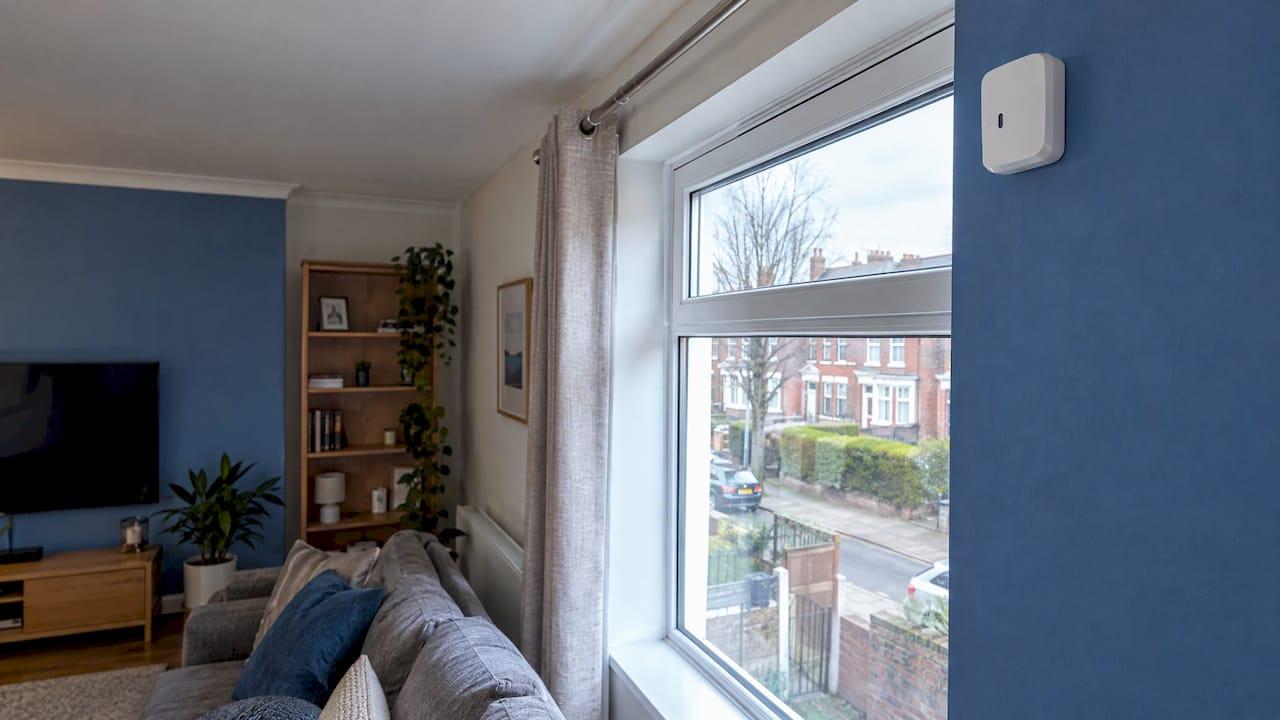
A glass break detector is a sensor that raises the alarm when a window or glass door is smashed, before anyone has stepped inside. It works best as one layer in a properly designed intruder alarm, chosen and positioned for your particular glass and rooms. That is why we specify, install and certify every system ourselves rather than leaving the detector choice to a catalogue.
This guide explains what the detectors sense, the main types, where they belong in a home, school, nursery, place of worship or business, and how to keep unwanted alarms down.
TL;DR
- A glass break detector recognises the sound of breaking glass, or senses a physical change in the pane, and signals the alarm control panel, which sounds the alarm or alerts you.
- Acoustic detectors listen for sound; physical ones use a metal strip or ultrasonic waves on the glass. The right choice depends on your glass and the room.
- Position, glass type and room use decide how well a detector performs, so a site survey beats guessing from a product page.
- In schools, nurseries, churches and shops, detectors protect large glazed areas where door and window contacts alone leave gaps.
- We design, fit and SSAIB-certify the whole system with one engineer, with no subcontractors.
Table of Contents
- What a glass break detector actually does
- The main types of glass break detector
- Where to put a glass break detector
- Reliability, false alarms and the dog question
- Glass break detectors in homes
- Glass break detectors in schools, nurseries and places of worship
- Tampering and inspection
- A sensible way to plan your detectors
- Why the engineer matters more than the sensor
- Talk to us about your property
- FAQ
- Sources
What a glass break detector actually does
Most burglars do not pick a lock. They go through the weakest point, and a pane of glass is often exactly that. A glass break detector watches that point.
The UK government's National Protective Security Authority (NPSA), which advises on protecting buildings, describes the job simply: the detector spots a broken window either by recognising the sound of breaking glass or by sensing a physical change at the window. It then sends a signal to the alarm's control electronics, which trigger the audible or visual alarm, or the alert sent to you.
The key point is timing. A door contact only trips when a door opens. A motion sensor only trips when someone moves inside the room. A glass break detector trips at the moment of entry, which can be the earliest warning you get on a ground-floor window.

How it fits with the rest of an alarm
A detector on its own does nothing useful. It is one input to the alarm panel, alongside door contacts, movement sensors, keypads and sirens. The panel decides what happens next: a siren, a push notification to your phone, or a call to a monitoring centre. If the system is a police-response monitored one, the signal can go on to a monitoring centre, which is why the quality of the whole design matters more than any single sensor.
The main types of glass break detector
There are two broad families. Understanding the difference helps you see why one house or building needs one type and another needs a mix.
Acoustic detectors
These contain a microphone. According to the NPSA, acoustic glass-break sensors register the sound of breaking glass and send an alert. A single unit fixed to a wall or ceiling can cover several panes in a room, which makes acoustic types popular for living rooms, offices, classrooms and halls with a lot of glazing.
Good acoustic detectors do not react to just any noise. Rather than a single loud sound, they are built to look for the pattern of a break: typically a sharp impact followed by the higher-pitched sound of fragments. Different manufacturers handle this in different ways, which is one reason the model you choose matters.
Physical (vibration and contact) detectors
The NPSA also describes physical detection: either a metal-strip circuit on or embedded in the glass, or ultrasonic waves sent across the pane that are disturbed when the glass breaks. These watch the glass itself, pane by pane, rather than listening to the room.

Combined sensors
Some products pair a movement sensor with a glass break detector in one housing. These suit rooms where you want both layers from a single device, such as a conservatory or a shop front office. Whether one is the right answer depends on the room, which is why we decide this on site rather than from a brochure.
Which type suits which situation
| Situation | Usually suits | Why |
|---|---|---|
| Living room or lounge with patio doors | Acoustic detector | One device covers the glazed wall of the room |
| Classroom, hall or nursery room with several windows | Acoustic detector | Covers a run of windows without wiring every pane |
| Single high-value pane, such as a display window | Physical detector | Watches that specific piece of glass |
| Conservatory | Acoustic or combined sensor | Large glass area, often with movement cover wanted too |
| Church or community hall with decorative or leaded glazing | Specified after survey | Glass type and layout vary widely |
Treat this as a starting point. The right choice comes from standing in the room and looking at the glass.
Where to put a glass break detector
Placement is where most of the performance is won. Three things matter.
Line of sight to the glass. Acoustic detectors listen for sound travelling from the pane to the microphone, so the device should face the glazing it protects, in the same room. Curtains, blinds and furniture can muffle or distort the sound of a break, so think about what hangs in front of the window.
Distance and room size. Every model has a stated coverage range, and it differs between products. The figure on the box assumes ideal conditions. A large church hall with a high ceiling is a different job from a small kitchen, and a survey establishes whether one detector is enough or two are needed.
Keeping it away from noise sources. Fitting a detector next to a speaker, siren, extractor or a draughty vent invites trouble. Quiet, stable positions on a wall or ceiling opposite or beside the glazing are normally better than awkward corners.
A few related points apply to every property:
- Check glass that has been changed. Adding film, a coating, secondary glazing or replacing panes with different glass can change how a break looks to the detector. If you have done any of this, tell your installer.
- Cover every glazed entry point that can be reached. Ground-floor rear windows, side doors with glass panels and flat roofs are where intruders often look first.
- Do not rely on glass break detection alone. A detector inside the room and a contact on the door give you overlapping cover.
Reliability, false alarms and the dog question
People often ask whether a dog barking can set off a glass break detector. A well-chosen, correctly positioned detector is designed to look for the characteristic pattern of breaking glass, not general noise. Some manufacturers describe a two-stage approach, requiring an impact followed by the high-frequency sound of fragments within a short window, precisely so that barking and passing traffic do not count.
The NPSA does note that similar sound waves can cause false alarms in acoustic detectors, and gives the example of keys being dropped. The practical answer is to treat that as a design task:
- Choose a detector with pattern recognition rather than the cheapest sound trigger.
- Position it according to the room, not the easiest cable run or shelf.
- Set sensitivity for the space. A school hall that echoes needs different settings from a carpeted bedroom.
- Pair it sensibly with other sensors so the panel can tell a real intrusion from a one-off noise.
- Test it after fitting, using a proper glass break simulator rather than breaking anything.
An annual service is where drift gets caught: a changed layout, new curtains, a moved cabinet, or a detector that has been knocked. We offer annual servicing and SSAIB-certified maintenance so detectors keep performing as the building changes.
Glass break detectors in homes
For a house, the places that matter most are the ones that are hidden from the street and the ones with the most glass: patio doors, a conservatory, a kitchen window overlooking the back garden, and glazed side doors.
A detector is particularly valuable where you have large glazing and want to be able to sleep or work in other rooms. It gives early warning at the point of entry rather than waiting for the intruder to cross the room. Our home security work covers burglar alarms, home CCTV, smart doorbells and smart home integration, so the detectors can sit alongside the rest of your system and be controlled from an app.
If you have pets, say so at the survey. It affects where sensors go and how they are set, and a sensible layout means everyone, including the dog, can move around normally.
Glass break detectors in schools, nurseries and places of worship
These buildings share a challenge: lots of glass, lots of people at some times, and empty for long periods at others.
Schools and nurseries. Classrooms, entrance lobbies and playroom windows face the outside. Acoustic detectors cover multiple panes in a room without wiring each one, and they can feed the same alarm panel that handles door contacts and movement detection. Manufacturer literature lists schools among the typical places where glass break detectors are used, alongside shops, museums, restaurants and offices. We also provide lockdown systems for schools and event centres, which sit comfortably beside an intruder alarm that protects the building out of hours.
Places of worship. Stained or leaded glass, high windows and large open interiors all affect detector choice. Some windows are protected on the outside; some are too valuable to fit anything to. This is exactly where a survey earns its keep, because the answer is different in every building.
Shops and offices. A glazed frontage is the obvious target. A detector inside the shop, combined with movement detection and, where needed, CCTV with remote viewing, gives you both the alert and the evidence. For doors you want only certain people to use, access control handles who comes and goes during the day, while the alarm handles the building when it is empty.
Construction and temporary sites. Site cabins and offices have glazing too. Our construction sector page explains how we approach temporary and live sites.
Tampering and inspection
The NPSA cautions that microphones and thin metal strips can be susceptible to tampering, and says detectors should sit where a security officer can oversee and inspect them. For a business, that translates into three habits: put detectors where staff see them in the normal course of the day, include them in opening and closing checks, and keep them in the maintenance schedule. Wider commercial property security issues, such as vulnerable entry points and regular inspection, are worth reviewing at the same time.
A sensible way to plan your detectors
Whether you are protecting a three-bed semi in Wigan or a nursery in Warrington, the same sequence works.
- Walk the building and list every pane that can be reached. Include doors with glass panels, roof lights and anything over a flat roof.
- Note the glass. Is it standard, double glazed, filmed, decorative or leaded? Has anything been added?
- Decide the layers. Which windows need a detector, which only a contact, which are covered by movement sensors in the room?
- Choose the detector type for each room. One acoustic device for a glazed room, a physical detector for a single valuable pane.
- Place and set it for the room. Line of sight, distance, noise sources and sensitivity.
- Test it with a simulator and record the result.
- Review it every year. Layouts change, and detectors should change with them.
Steps 1 to 3 are where an experienced engineer saves you from buying the wrong thing, and steps 4 to 6 are where installation quality shows. With us, the engineer who surveys and specifies is the one who fits and certifies, so nothing is lost between a salesperson and a fitter.
Why the engineer matters more than the sensor
Detector specifications are published and, to a large extent, similar. What varies is whether the right detector went in the right place for the right glass. That is a judgement made on site, and it is the difference between an alarm that is trusted and one that gets switched off because it keeps going off.
For homeowners, that means fewer nuisance alarms and a system you are happy to set every night. For a school or nursery, it means staff are not dealing with false calls at 6am. For a church or business, it means the alarm is documented, maintained and, if it is a monitored system, accepted by the monitoring route you have chosen.
Our view
We have been fitting alarms for more than 20 years, and the pattern is consistent: a glass break detector is only as good as the decision behind it. The decision is about the glass, the room, the people who use it and what else is protecting the building.
That is why one engineer handles the whole job here. The person who walks your property, designs the system, installs it and certifies it to SSAIB standards is the same person, with no salespeople and no subcontractors in between. If a detector is the right answer for a patio door, a classroom or a church window, it goes in because it was specified for that room, and you get a clear fixed quotation before anything starts.
We would rather spend an hour at the survey than a week dealing with callbacks. And if you ever need us afterwards, our 24-hour callout and annual servicing are there for exactly that.
Freddie
Talk to us about your property
We design, install and SSAIB-certify intruder alarms, CCTV, access control and intercoms for homes, schools, nurseries, places of worship and businesses across Liverpool and the North West, including Warrington and Wigan. Every job starts with a site survey and ends with a fixed quotation.

If you want glass break detection as part of a new alarm, an upgrade or a system takeover, start with our commercial intruder alarm page, or get in touch through our website and we will arrange the survey.
FAQ
What does a glass break detector detect?
It detects a window or glass door being broken. Acoustic types listen for the sound of breaking glass, and physical types sense a change in the pane itself, such as a broken metal strip circuit or disturbed ultrasonic waves. Either way, the detector signals the alarm panel, which then sounds the alarm or alerts you.
Can a dog barking set off a glass break detector?
A properly chosen detector is built to look for the pattern of a break rather than any loud noise, so normal barking should not trigger it. Position and sensitivity settings matter, which is why we set them for the room and the household at installation.
Do I need a glass break detector if I already have door and window contacts?
Contacts only trip when a door or window opens, whereas a glass break detector reacts when glass is smashed. For rooms with large glazing, such as patio doors, a conservatory or a shop front, the two work together and give you cover at different moments of an attempted entry.
Can glass break detectors be added to an existing alarm?
Often they can, depending on the panel and the type of system you already have. We also take over existing systems, so we can survey what is there and advise on adding detectors where the glazing needs them.
How often should glass break detectors be checked?
Have them tested as part of your annual service, and after any change to the room such as new curtains, film on the glass or replacement windows. Our servicing and maintenance covers this.
Sources
- NPSA: Intrusion detection
- Glass break detectors leaflet (Keenfinity Group)
- Commercial property issues to take seriously